Table of Contents
- What Defines Precision Engineered Firearm Components
- CNC Machining for Firearm Parts: The Foundation of Modern Manufacturing
- Best Materials for Firearm Components and Why They Matter
- Firearm Component Manufacturing Tolerances and Dimensional Accuracy
- Quality Control and Inspection Protocols
- Surface Finishing and Protective Coatings
- Regulatory Compliance and ITAR Considerations
- Testing, Validation, and Real-World Performance
Last Updated: August 11, 2026
What Defines Precision Engineered Firearm Components
Precision engineered firearm components are manufactured parts built to exacting tolerances and specifications, designed to function reliably across different firearm platforms. These components form the backbone of modern firearms, from frames and slides to internal mechanisms like firing pins and striker rods. The distinction between standard parts and precision engineered components lies in dimensional accuracy, material selection, and manufacturing consistency.
At Polymer Pew, we understand that precision engineered firearm components aren’t just about tight tolerances, they’re about reliability when it matters most. Whether you’re building a custom rifle, upgrading a platform, or assembling a complete firearm from individual pieces, every component must perform consistently. The engineering behind these components involves multiple disciplines: CAD design, metallurgy, CNC machining, and quality assurance protocols. Understanding what makes a component "precision engineered" helps you make informed decisions about your builds and know what questions to ask suppliers.
CNC Machining for Firearm Parts: The Foundation of Modern Manufacturing
CNC machining represents the foundation of modern precision engineered firearm component manufacturing, enabling manufacturers to produce parts with dimensional accuracy impossible to achieve through manual methods. Computer numerical control machines use programmed instructions to guide cutting tools through precise movements, removing material from a blank to create finished components.
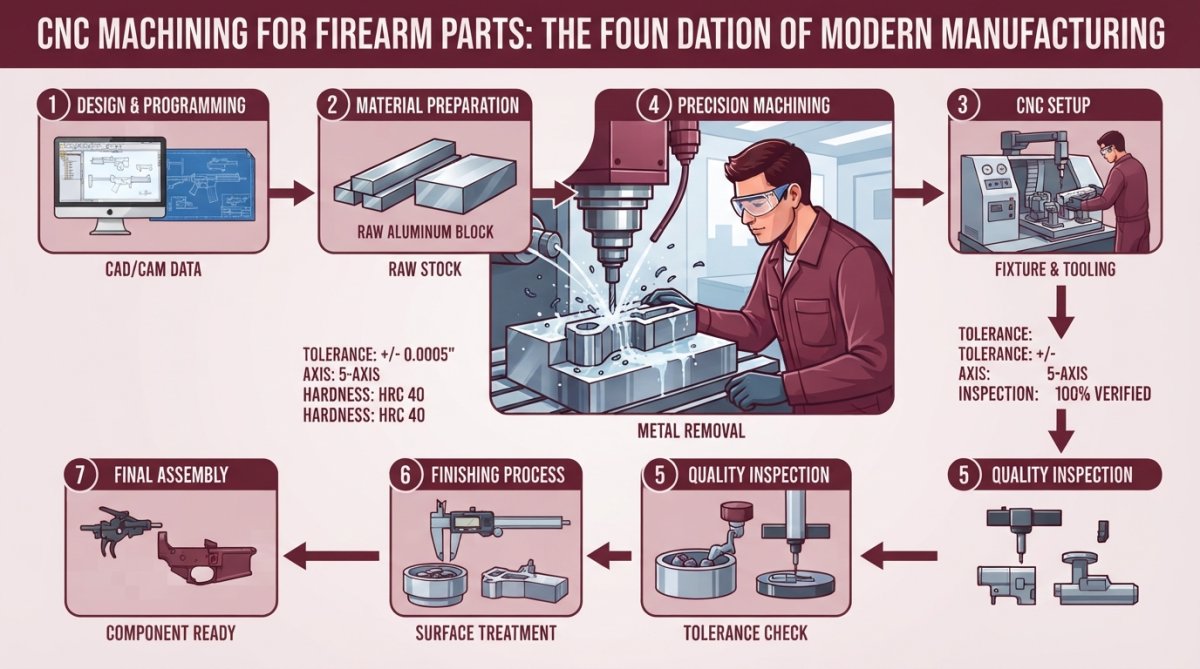
The CAD design process precedes CNC machining. Engineers create detailed digital blueprints that define every dimension, angle, and surface finish requirement. These designs translate directly into machine code that controls tool paths, spindle speeds, and feed rates. For a component like an MKE lower receiver or trigger assembly, the CAD file might specify dozens of features: hole locations precise to within 0.001 inches, angled surfaces, internal channels, and mounting points that must align perfectly with mating components.
Multi-axis machining, typically 3-axis, 4-axis, or 5-axis configurations, allows manufacturers to machine complex geometries from multiple angles without repositioning the workpiece. A 5-axis machine can approach a workpiece from nearly any angle, reducing setups required and minimizing handling that introduces dimensional errors. This capability is particularly valuable for complex internal geometries and components with angled features.
The choice of cutting tools, coolant types, and machining parameters directly impacts final component quality. Carbide tools maintain sharp edges longer than high-speed steel, reducing tool wear that degrades dimensional accuracy during long production runs. Manufacturers optimize these parameters through testing, then maintain them rigorously to ensure batch-to-batch consistency.
The most common mistake in firearm component manufacturing is inadequate tool maintenance. As cutting tools wear, they produce slightly larger holes and less precise surfaces. Shops that change tools on a strict schedule maintain tighter tolerances throughout long production runs.
Best Materials for Firearm Components and Why They Matter
Material selection determines whether a precision engineered firearm component will function reliably for thousands of rounds or fail prematurely under stress. Different components demand different material properties.
Steel dominates firearm component manufacturing because it offers the strength-to-weight ratio and durability required for repeated firing cycles. Common alloys include 12L14 steel, ideal for triggers and internal parts due to excellent surface finishes; 1018 steel, offering good machinability with higher strength; and 1144 steel, providing enhanced hardness and wear resistance for high-stress components.
Aluminum components, particularly for receivers and housings, offer weight reduction and corrosion resistance compared to steel. Anodized aluminum provides a hard, protective surface that resists wear and corrosion. Polymer Pew’s aluminum MKE lower receivers combine the weight savings of aluminum with the durability of anodized finishes and hardened stainless steel internals.
Stainless steel appears in internal components like springs, firing pins, and striker rods where corrosion resistance matters. While stainless steel is harder to machine than carbon steel, the corrosion resistance justifies the additional manufacturing complexity.
Heat treatment processes, hardening and tempering, refine grain structure and adjust hardness levels. This balance between hardness and toughness is critical; a component that’s too hard becomes brittle and prone to cracking, while one that’s too soft wears quickly.
The material choice for any precision engineered firearm component reflects a deliberate trade-off between machinability, strength, corrosion resistance, and cost. The best choice depends on the component’s specific function and stress environment.
Firearm Component Manufacturing Tolerances and Dimensional Accuracy
Tolerances define the acceptable range of variation for each dimension on a precision engineered firearm component. A tolerance might specify that a hole diameter must be 0.500 inches plus or minus 0.005 inches, meaning acceptable dimensions range from 0.495 to 0.505 inches. This seemingly small range determines whether components fit together smoothly or require modification.
High tolerance manufacturing for firearm components typically specifies tolerances between 0.001 and 0.005 inches for critical dimensions. Receiver pin holes, trigger pocket dimensions, and barrel extension threads fall into this category. The tighter the tolerance, the more expensive and time-consuming the manufacturing process becomes.
Dimensional accuracy depends on multiple factors working together. CNC machine calibration must be verified regularly using precision gauge blocks. Tool wear monitoring catches degradation before it produces out-of-tolerance parts. Thermal expansion matters; a component machined in a cold shop might expand slightly as the facility warms, shifting dimensions. Professional shops maintain consistent temperature and humidity to minimize these effects.
| Tolerance Level | Typical Range | Common Applications | Inspection Frequency |
|---|---|---|---|
| Loose | ±0.010" or greater | Non-critical external features | Periodic sampling |
| Standard | ±0.005" to ±0.010" | Most firearm components | Every 10-50 parts |
| High | ±0.001" to ±0.005" | Receiver pin holes, trigger pockets | Every 5-10 parts |
| Precision | ±0.0005" or tighter | Critical mating surfaces, threads | Every part or 100% inspection |
The relationship between tolerances and functionality is direct. A receiver pin hole that’s too large allows the pin to move, creating play that affects reliability. A trigger pocket that’s slightly too wide allows the trigger assembly to shift, affecting trigger pull consistency.
Quality Control and Inspection Protocols
Quality control separates reliable precision engineered firearm components from parts that might function inconsistently or fail under stress. Professional manufacturers implement multi-stage inspection protocols that catch errors before components reach customers.
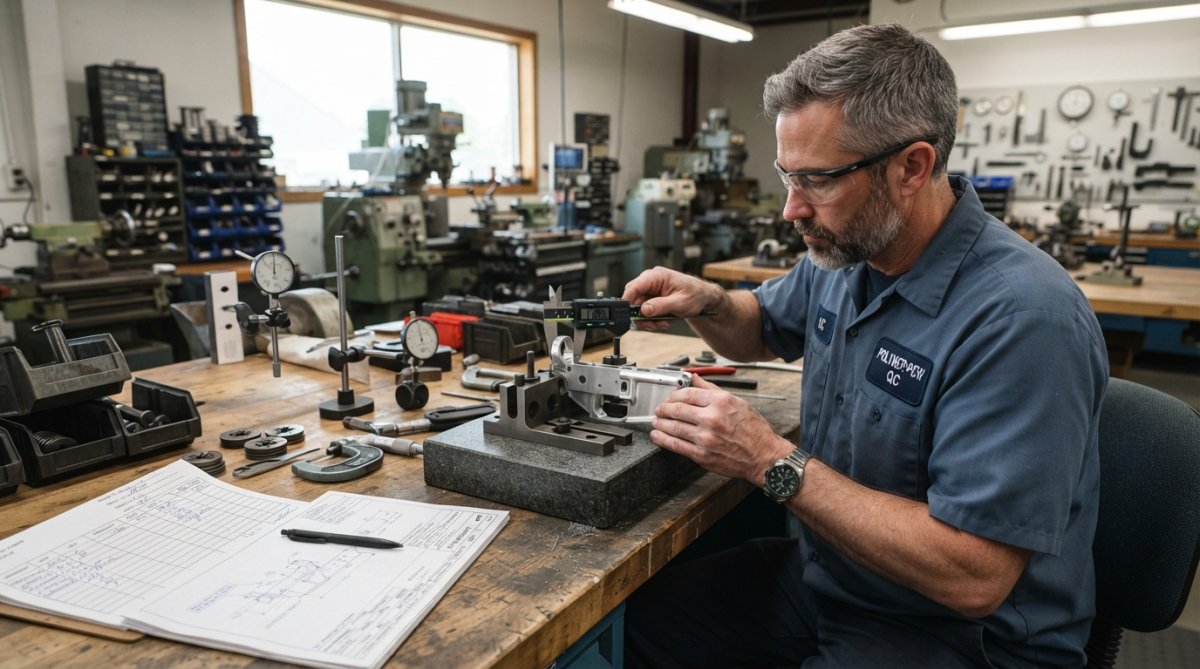
First-piece inspection occurs when production begins. A technician measures the first component produced from a new setup, verifying that all critical dimensions fall within specification. If the first piece is out of tolerance, the setup is adjusted before production continues.
In-process inspection happens periodically during production runs. Automated systems using CMM (coordinate measuring machine) technology can measure components in seconds, checking dozens of dimensions simultaneously. Manual inspection using calipers, micrometers, and gauges supplements automated systems for features that automated systems struggle with.
Components from shops that rely solely on first-piece inspection and skip in-process checks are higher risk. Tool wear and thermal drift can degrade tolerances during long production runs without anyone catching the problem.
Final inspection before shipment represents the last opportunity to catch defects. Components are measured, visually inspected for surface defects, and sometimes functionally tested. Documentation of inspection results creates accountability and traceability, allowing manufacturers to reference inspection records if customers report problems.
Surface Finishing and Protective Coatings
Surface finishing transforms raw machined components into durable parts resistant to corrosion and wear. The choice of finish affects appearance, corrosion resistance, durability, and cost.
Anodizing is the most common finish for aluminum components. The anodizing process creates a hard oxide layer on the aluminum surface that resists corrosion and wear. Type II anodizing, the standard for firearm components, produces a finish approximately 0.0007 inches thick. The anodized finish can be dyed various colors, black, dark earth, tan, allowing manufacturers to offer aesthetic options while maintaining protection.
Nitriding hardens the surface of steel components while maintaining tight tolerances. The nitriding process introduces nitrogen atoms into the steel surface, creating an extremely hard layer ideal for internal components like firing pins and trigger parts that experience wear from repeated cycling. Nitriding adds minimal dimension change, typically 0.0005 inches or less, making it compatible with high-tolerance manufacturing.
Stainless steel components often receive a passivation treatment that removes iron contamination from the surface, enhancing corrosion resistance. This chemical process allows the natural oxide layer to form more uniformly.
A component with inadequate surface protection will corrode, bind, or wear prematurely. Polymer Pew’s commitment to quality finishes, anodized aluminum housings and hardened stainless steel internals, ensures components maintain functionality throughout their service life.
Regulatory Compliance and ITAR Considerations
Precision engineered firearm components operate within a complex regulatory environment. The International Traffic in Arms Regulations (ITAR) control the export and technical disclosure of firearm-related articles, including components, designs, and manufacturing data. Domestic manufacturers must understand ITAR requirements to avoid violations that carry severe penalties.
ITAR designates certain firearm components as "articles" subject to export controls. This means components cannot be shipped internationally without proper licensing, and technical data about their manufacture cannot be shared with foreign nationals without authorization. The regulations define "technical data" broadly, including drawings, specifications, and manufacturing processes.
For domestic manufacturers and consumers, ITAR’s primary impact involves manufacturing documentation and technical disclosure. Manufacturers must be careful not to publicly share detailed manufacturing specifications or CAD files that could facilitate unauthorized manufacturing.
State regulations also govern firearm component manufacturing and sales. Manufacturers must ensure compliance with federal law and the laws of states where they operate and where customers reside.
Polymer Pew operates in full compliance with federal firearms regulations and ITAR requirements. Our commitment to legal operation ensures that customers receive components manufactured under proper regulatory oversight.
Testing, Validation, and Real-World Performance
Testing validates that precision engineered firearm components perform as designed under real-world conditions. Manufacturing specifications alone don’t guarantee reliability; components must be tested in actual firearms across various conditions and usage patterns.
Functional testing involves installing components in actual firearms and operating them through normal firing cycles. A trigger assembly might be tested for pull weight consistency, reset function, and binding across multiple firearm platforms. A receiver might be cycled thousands of times to ensure durability and confirm that internal dimensions remain stable.
Stress testing pushes components beyond normal operating conditions to identify failure modes and establish safety margins. A trigger might be cycled tens of thousands of times, or subjected to impact tests that simulate drops and rough handling.
Compatibility testing confirms that components function across multiple firearm platforms. A trigger assembly designed for AR-pattern firearms might be tested in a dozen different receiver types to confirm fit and function. This testing is particularly important for components like MKE lower receivers that must accommodate various upper receiver configurations and internal components from different manufacturers.
Environmental testing evaluates component performance under extreme conditions. Components might be tested after exposure to temperature extremes, humidity, salt spray, or cleaning solvents.
Documentation of test results provides evidence of component reliability. Customers who ask about test data should expect to see objective measurements and descriptions of testing protocols. Polymer Pew’s testing protocols ensure that components deliver the performance our customers depend on.
Precision engineered firearm components represent the intersection of advanced manufacturing, materials science, and rigorous quality control. The difference between components that function reliably and those that fail comes down to attention to detail at every stage, from CAD design through CNC machining, material selection, tolerance management, inspection, surface finishing, and testing. When you choose Polymer Pew components, you’re choosing precision engineered firearm parts built to exacting standards, tested for reliability, and backed by our commitment to quality. Our aluminum MKE lower receivers, specialized super safety kits, and flat triggers deliver the compatibility, durability, and performance you need for your custom builds. Get your Flatties here and experience the difference that true precision engineering makes.
Frequently Asked Questions
What defines a precision engineered firearm component?
A precision engineered firearm component is a part manufactured to exacting specifications using CNC machining and high-grade materials like 12L14 or 1018 steel and anodized aluminum. These components maintain tight dimensional tolerances, typically within thousandths of an inch, ensuring reliable functionality and interchangeability across firearm platforms. Precision engineering guarantees that parts fit correctly, perform consistently, and meet durability standards required for safe operation.
Why are CNC-machined parts preferred in modern firearms?
CNC machining delivers consistent, repeatable results that manual fabrication cannot match. Multi-axis CNC machines produce components with exact dimensional accuracy, eliminate human error, and enable complex geometries that enhance firearm functionality. CNC-machined parts achieve superior surface finishes, tighter tolerances, and faster production cycles, making them the industry standard for reliable, drop-in components that require minimal modification during installation.
What materials are most common in high-precision firearm manufacturing?
Steel alloys like 12L14, 1018, and 1144 are industry standards for firearm components due to their machinability, strength, and reliability. 12L14 steel offers excellent CNC performance and dimensional accuracy. Anodized aluminum is used for lower receivers and housings, providing durability with reduced weight. Stainless steel internals resist corrosion and wear. Material selection depends on the component's function: frames and slides require hardened steel, while some housings benefit from aluminum's weight savings and anodizing protection.
How do manufacturing tolerances affect firearm reliability?
Manufacturing tolerances determine how precisely components fit together and function. Loose tolerances cause binding, feeding issues, and inconsistent trigger performance. Tight tolerances ensure smooth operation, reliable chambering, and consistent pull weight on triggers. Precision engineered components maintain tolerances within 0.001 to 0.005 inches, guaranteeing that parts work together seamlessly. Tighter tolerances cost more to produce but deliver superior reliability, especially critical for components like triggers, strikers, and firing pins where consistency directly impacts safety and performance.
Are there specific standards for firearm component engineering?
Firearm manufacturers follow industry standards established by the Sporting Arms and Ammunition Manufacturers' Institute (SAAMI) for pressure, dimensions, and safety. ITAR (International Traffic in Arms Regulations) governs the design and export of firearm components. Individual manufacturers also establish their own internal quality and dimensional standards to ensure compatibility and reliability. Standards cover everything from chamber dimensions to trigger pull weight ranges, ensuring that precision engineered components meet safety requirements and perform consistently across different firearm platforms.
How can I verify that precision components will fit my firearm without modifications?
Precision engineered components from reputable manufacturers are designed and tested for specific firearm platforms, with detailed compatibility documentation. Drop-in parts like triggers, safeties, and lower receivers should come with specifications confirming fit for your exact platform variant. Before purchase, verify the component's technical specifications match your firearm's schematics. Quality manufacturers test components across multiple variants and provide clear guidance on installation. If you're uncertain, contact the manufacturer directly with your firearm's specifications, legitimate makers stand behind compatibility claims with testing data.
What's the difference between surface finish types on firearm components?
Surface finishes protect components from corrosion and wear while affecting appearance and function. Anodizing creates a hardened oxide layer on aluminum, offering excellent corrosion resistance and durability. Parkerizing provides a matte gray finish with good corrosion protection on steel. Nickel-boron and hard-chrome coatings reduce friction and improve reliability on internal parts like bolts and firing pins. Stainless steel offers natural corrosion resistance without additional coatings. The choice depends on the component's location and function: external parts prioritize corrosion protection, while internal parts benefit from low-friction coatings that enhance performance.
This article was written using GrandRanker