Table of Contents
- Performance Firearm Parts for Custom Builds: What Matters
- Trigger Assemblies and Spring Kits
- Barrel and Muzzle Device Upgrades
- AR-15 Platform Components and Receivers
- Best Budget Firearm Upgrade Kits
- How to Choose Custom Rifle Components
- Firearm Assembly Tools for Beginners
- Optic Mounts and Sight Systems
Last Updated: August 17, 2026
Performance Firearm Parts for Custom Builds: What Matters
Building a custom rifle means choosing components that work together seamlessly. The difference between a rifle that runs flawlessly and one that requires constant tweaking comes down to understanding how each performance firearm part contributes to reliability, accuracy, and function.
At Polymer Pew, we’ve spent years helping builders navigate this landscape. The core challenge isn’t finding parts, it’s finding parts that actually fit your platform, match your intended use, and won’t fail under stress. This guide breaks down the essential performance firearm parts you need to consider, what separates budget options from premium upgrades, and how to avoid the mistakes that waste both time and money.
The biggest mistake builders make is treating all performance upgrades the same. A $100 trigger improvement matters far more than a $100 handguard swap. Prioritize upgrades that directly affect accuracy, reliability, or ergonomics, everything else is secondary.
Trigger Assemblies and Spring Kits
Your trigger is the single most important performance firearm part you’ll choose. It directly affects accuracy, follow-up shot speed, and shooter confidence. A quality trigger reduces take-up, delivers a crisp break, and resets fast enough for rapid fire.
Single-Stage vs. Two-Stage Triggers
Asingle-stage trigger breaks cleanly with minimal pre-travel, favoring speed and competitive shooting. A two-stage trigger has take-up feedback followed by a crisp break, favoring precision and accuracy at distance.
For custom builds under 300 yards, single-stage triggers dominate. For precision rifle work beyond 300 yards, two-stage triggers give you the feedback necessary for consistent shot placement.
The RISE Armament Rave 140 is a single-stage drop-in trigger with a 3.5-pound pull and crisp break, built from heat-treated tool steel with anti-walk pins. For speed and competition, the Geissele Automatics Super Dynamic 3-Gun trigger offers a hybrid feel with adjustable spring kits (3.0-5.5 lbs).
Spring kits matter more than most builders realize. A trigger with adjustable springs lets you fine-tune pull weight without replacing the entire trigger. Test different spring combinations before settling on one.
Drop-In Trigger Installation
Drop-in triggers are self-contained units that replace your factory trigger group without additional gunsmithing. The advantage is simplicity, installation takes under 10 minutes on a standard receiver. The limitation is compatibility; verify that your lower receiver is mil-spec compatible before ordering.
Polymer Pew’s flat triggers are designed as drop-in replacements for standard AR-platform lowers. They come with anti-walk pins and require no additional tools beyond a punch to remove factory trigger pins.
Quality drop-in triggers are tested across multiple platforms before release. Budget options sometimes skip this step, leading to reliability issues that show up only after hundreds of rounds.
Barrel and Muzzle Device Upgrades
Your barrel dictates accuracy potential and recoil characteristics. A quality barrel with proper twist rate and crown ensures that ammunition performs as designed.
Barrel Profile and Twist Rate
Barrel profile refers to the outer contour. A pencil profile is lightweight but heats up faster. A government profile balances weight and heat dissipation. A bull barrel is heavy but maintains zero through extended shooting.
Twist rate is the rifling’s rotation per inch. Common twist rates are 1:7 (stabilizes heavier rounds), 1:9 (versatile, handles 55-77 grain), and 1:12 (prefers lighter rounds). Mismatch twist rate to ammunition weight and your barrel will produce poor accuracy.
The Faxon Firearms 16" Gunner Barrel splits the difference between weight and stability. Machined from 4150 CMV steel with salt bath nitride finish for corrosion resistance, it’s available in 1:7 and 1:9 twist rates. Barrel quality compounds over time; a quality barrel maintains accuracy across thousands of rounds while a cheap barrel loses zero and develops keyholing.
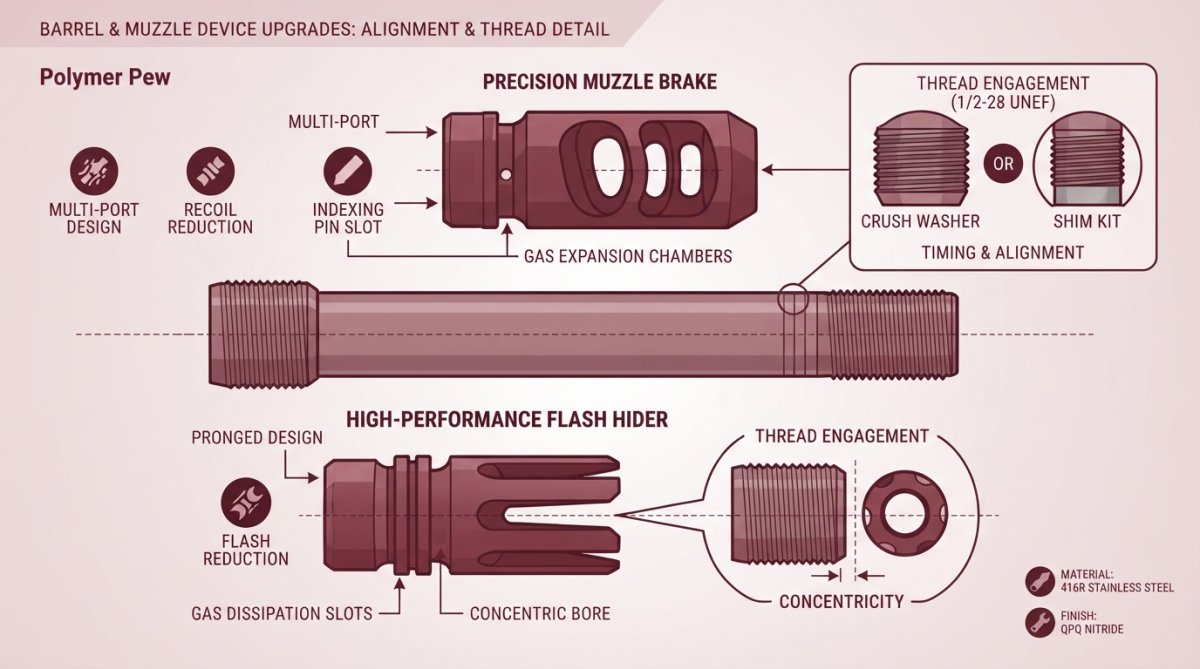
Muzzle Devices and Recoil Reduction
Muzzle devices manage recoil and redirect gas. A flash hider reduces visible muzzle flash. A muzzle brake redirects rearward gas to counteract recoil by 25-40%. A suppressor reduces sound and recoil (where legal).
For precision rifle builds, brakes matter because reduced recoil means faster sight recovery and more consistent follow-up shots. For general-purpose rifles, the noise increase often isn’t worth the benefit unless you’re shooting alone.
Installation requires a barrel nut wrench and typically a headspace gauge if you’re changing devices. Polymer Pew offers muzzle devices that thread onto standard 1/2×28 or 5/8×24 barrels.
AR-15 Platform Components and Receivers
The receiver is the foundation of your build. Everything else bolts to it. Receiver quality, compatibility, and tolerance directly affect how well all other components fit and function.
Upper and Lower Receiver Compatibility
The upper receiver houses the barrel, bolt carrier group, and charging handle. The lower receiver houses the trigger, magazine well, and buffer tube. They connect at two pivot points and must be in tolerance to lock up properly.
Mil-spec receivers are standardized and accept standard components without fitting. For custom builds, mil-spec compatibility is your safest bet. Polymer Pew’s aluminum MKE lower receivers are tested for variant compatibility, meaning they accept components from multiple manufacturers without requiring modifications.
Upper receivers must match your barrel profile and gas system length. A carbine-length gas system requires specific components; rifle-length systems use different components. Mismatching creates reliability issues.
Bolt Carrier Group Selection
The bolt carrier group (BCG) is the moving part that cycles the action. It must match your gas system, barrel profile, and intended use. Standard mil-spec BCGs are reliable and affordable. Adjustable BCGs let you tune gas flow for specific ammunition or conditions.
Material matters. Bolt carriers are typically forged steel or billet steel. A quality BCG resists wear and maintains reliability across thousands of rounds. For Polymer Pew builds, standard mil-spec BCGs integrate seamlessly with compatibility testing ensuring reliable cycling.
Best Budget Firearm Upgrade Kits
Budget builds don’t mean unreliable builds. Strategic choices let you save money on non-critical components while investing in parts that directly affect performance.
Drop-In Kit Benefits and Compatibility
A drop-in kit bundles trigger, safety, and sometimes springs into a single package. The benefit is convenience and guaranteed compatibility; the manufacturer tested all components together. The limitation is flexibility, a kit locks you into specific choices.
Budget kits from Polymer Pew offer significant savings versus buying components separately. The trade-off is typically in materials or finish, but function and reliability are identical. Compatibility is where budget kits shine; they’re tested on multiple platforms before release, eliminating the risk of buying components individually and discovering they don’t work together.
Testing and Reliability Standards
Reliability testing separates quality budget kits from cheap kits that fail. A quality kit undergoes function testing across multiple platforms and ammunition types. Ask manufacturers about testing protocols and warranty coverage.
Polymer Pew tests kits across multiple platform variants and ammunition weights before release, ensuring that what you buy actually works. Warranty backing indicates manufacturer confidence in reliability.
| Kit Type | Best For | Installation Time |
|---|---|---|
| Budget drop-in kit | First-time builders, general purpose | Under 15 minutes |
| Premium trigger + separate parts | Competition shooters, precision builds | 20-30 minutes |
| Matched component kit | Balanced performance and value | 15-20 minutes |
| Custom assembled kit | Specific requirements, tuned builds | 30+ minutes |
How to Choose Custom Rifle Components
Choosing components means understanding your platform, your use case, and which upgrades actually matter for your goals.
Platform Compatibility and Tolerances
Before buying anything, know your platform. Is it mil-spec? Is it a tight-tolerance clone? Does it use standard AR-15 dimensions or proprietary specs?
Mil-spec means standard; most components fit without modification. Tight-tolerance platforms require hand-fitting or components specifically designed for that platform. Check your lower receiver documentation or contact the manufacturer.
Polymer Pew’s aluminum MKE lowers are tested for compatibility with standard mil-spec components, allowing you to source barrels, bolt carrier groups, and triggers from multiple manufacturers without worrying about fit issues.
Performance Benchmarking and Testing
Before committing to an upgrade, understand what it actually improves. A trigger upgrade improves accuracy and follow-up speed. A barrel upgrade improves accuracy and consistency. A handguard upgrade improves ergonomics but doesn’t directly affect accuracy.
Prioritize upgrades that address your specific weakness. Test before and after when possible by shooting groups with your current setup, installing the upgrade, then shooting groups again. Document your baseline performance, then upgrade one component at a time and measure the change.
Firearm Assembly Tools for Beginners
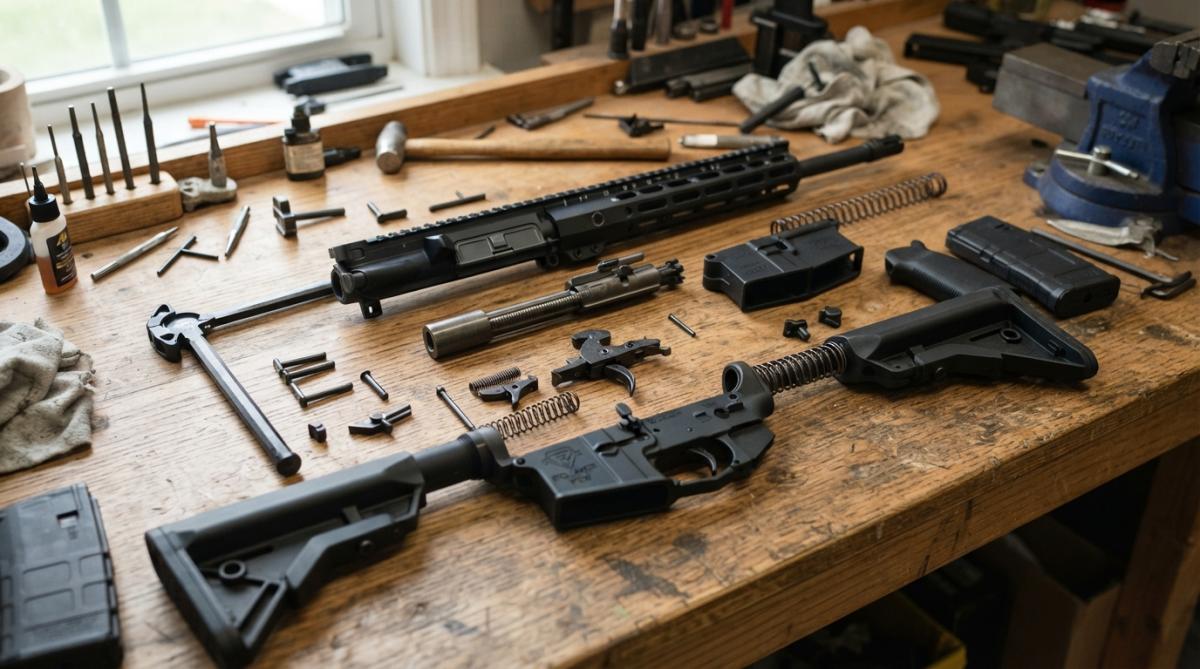
Building a custom rifle requires specific tools. Most are affordable and reusable across multiple builds.
Essential Tools and Armorer Resources
A basic assembly toolkit includes:
- Roll pin punch set (brass or polymer, not steel)
- Hammer or mallet (rubber preferred)
- Barrel nut wrench (specific to your upper receiver design)
- Torque wrench (ensures proper tightness)
- Cleaning rod and patches
- Headspace gauge (critical for safe builds)
These tools run $50-150 total for quality options. A single build recovers the cost.
Manufacturer instructions come with most components and detail installation steps. Polymer Pew provides assembly guides with all kits and components, covering installation sequence, torque specifications, and common mistakes.
Common Installation Mistakes to Avoid
The most common mistake is over-tightening. Barrel nuts, receiver extensions, and gas blocks all have specific torque specs. Over-tightening strips threads, cracks components, or binds internal parts. Use a torque wrench and follow manufacturer specs.
Another frequent error is incorrect roll pin installation. Installing them backwards, at an angle, or incompletely causes components to shift during firing. Use a proper roll pin punch and tap straight through.
Headspace issues cause dangerous failures. If you’re installing a new barrel or bolt carrier group, verify headspace with a headspace gauge. Too much headspace causes case rupture; too little prevents the bolt from closing.
Gas system length mismatches cause reliability problems. A carbine-length barrel needs carbine-length gas tube and components. Mismatching causes short-stroking or over-gassing.
Never assemble a firearm without verifying headspace. A simple headspace check takes five minutes and prevents catastrophic failures. If you’re unsure about headspace, contact an armorer or the component manufacturer before assembly.
Optic Mounts and Sight Systems
Your optic is only as good as its mount. A quality mount maintains zero across thousands of rounds. A poor mount loses zero, shifts, or fails under recoil.
Optic mounts integrate with your upper receiver. Picatinny rail mounts are standard on most AR-15 uppers. M-LOK and KeyMod mounts work with modern handguards. Quality mounts use precision machining and hardened steel, tested to maintain zero under recoil and temperature changes.
Sight systems fall into two categories: iron sights (mechanical backup) and optics (magnified or red dot). Most modern builds use an optic as primary with iron sights as backup. For budget builds, a basic red dot sight and quality mount deliver significant accuracy improvement. For precision builds, a quality magnified scope on a quality adjustable mount is worth the investment.
Building a custom rifle means understanding how each performance firearm part contributes to reliability, accuracy, and function. Start with quality trigger and barrel upgrades, they deliver measurable improvements. Add compatibility-tested components like Polymer Pew’s drop-in kits to eliminate fitting issues. Test before and after each upgrade to understand what actually matters for your platform. With the right components and proper assembly, you’ll build a rifle that runs reliably and performs consistently for years.
Get your performance firearm parts from Polymer Pew and experience the difference that tested compatibility and quality construction deliver to your custom build.
Frequently Asked Questions
What are the essential performance parts for a custom rifle build?
Essential performance firearm parts include a quality trigger assembly with reliable spring kits, a precision barrel matched to your caliber and twist rate, a compatible upper and lower receiver, and a functional bolt carrier group. Adding optic mounts, handguards, and muzzle devices further enhances performance. Start with components tested for your specific platform to ensure reliability and accuracy without compatibility issues.
How do aftermarket triggers improve firearm performance?
Aftermarket triggers reduce trigger pull weight, minimize creep, and provide a crisper break point, all critical for faster target acquisition and follow-up shots. A quality trigger improves shot consistency and reduces shooter fatigue during extended use. Drop-in triggers offer ease of installation without gunsmithing, while adjustable triggers let you fine-tune pull weight and reset speed to match your shooting discipline, whether competition or precision work.
Are custom firearm parts compatible with all platforms?
No. Compatibility depends on platform type, AR-15, AR-10, precision rifle chassis systems, and clone platforms have different receiver dimensions, rail systems, and tolerances. Before purchasing performance firearm parts, verify your specific platform variant. Polymer Pew's aluminum MKE lowers and drop-in kits are tested across multiple variants, but always confirm receiver type, magazine well, and rail compatibility before assembly to avoid costly modifications.
What should I look for when choosing parts for a custom build?
Prioritize platform compatibility first, confirm your receiver type and variant. Evaluate trigger pull weight and reset speed for your intended use (competition, precision, duty). Check barrel twist rate against your ammunition. Verify handguard mounting system and optic rail type. Consider material durability: hardened stainless steel internals and anodized aluminum housings last longer than budget alternatives. Read user feedback on drop-in parts to confirm they install without binding or modifications.
Is it cheaper to build your own gun or buy one?
Building a custom rifle can be cost-effective if you prioritize budget-friendly drop-in kits and avoid premium components. However, total cost depends on your component choices, precision triggers and barrels add expense quickly. The real advantage is customization: you select exactly the performance upgrades your platform needs. Budget builds work well for training and sport shooting; precision builds for competition or long-range work cost more but deliver superior reliability and accuracy tailored to your goals.
This article was written using GrandRanker