Table of Contents
- Selecting the Right Action for Your High Performance Build
- Match-Grade Barrel Selection and Harmonics
- Trigger Performance and Break Optimization
- Essential Gunsmithing Tools for Home Builds
- Firearm Component Compatibility Checklist
- Best Budget Firearm Upgrade Kits Without Compromise
- Maintenance, Reliability Testing, and Long-Term Performance
- Conclusion
Last Updated: August 23, 2026
Selecting the Right Action for Your High Performance Build
The action is the foundation of any high performance firearm build. It’s the mechanical system that chambers, fires, and ejects rounds, everything else bolts onto this core component. Get the action wrong, and no amount of premium barrels or triggers will save your build.
When selecting an action, you’re making a choice between reliability, accuracy potential, and budget. Bolt action rifles dominate precision shooting because they offer superior headspace control and consistency. Semi-automatic actions trade some accuracy potential for faster follow-up shots and higher round capacity. For a high performance build, bolt action remains the standard if precision is your priority.
Match-grade actions come pre-reamed and headspaced to tighter tolerances than standard production parts. This matters. A standard action might have headspace variance of 0.005 inches; a match-grade action holds 0.002 inches or better (peer-reviewed research). That precision compounds when you add a quality barrel and trigger. The investment in a precision action eliminates variables that would otherwise limit your accuracy.
Consider your platform carefully. If you’re building a clone of an existing rifle system, verify that your chosen action is compatible with the upper receiver, magazine well, and stock system you plan to use. Incompatibility here means wasted money and frustration. Polymer Pew’s aluminum MKE lower receivers, for example, are tested across multiple action types to ensure drop-in compatibility without requiring gunsmithing modifications.
Budget-conscious builders often ask whether a standard commercial action can deliver match-grade results. The honest answer: partially. A standard action with a quality barrel and trigger will outshoot most shooters. But it won’t reach the same accuracy ceiling as a match-grade action. If you’re building for competition or long-range precision work, the match-grade action is non-negotiable. If you’re building a reliable hunting rifle or tactical platform, a standard action works fine.
Match-Grade Barrel Selection and Harmonics
The barrel is where velocity consistency happens. A quality barrel with tight chamber tolerances and consistent bore diameter directly impacts your ballistic coefficient and muzzle velocity. Match-grade barrels are held to stricter specifications than commercial barrels, typically with bore runout under 0.003 inches (peer-reviewed research).
Barrel harmonics determine how your barrel vibrates during firing. When a round ignites, the barrel flexes. If that flex is consistent from shot to shot, your bullets exit at the same angle every time. This translates to tighter groups. Barrels with poor harmonics produce unpredictable bullet paths regardless of trigger control or optics quality.
The relationship between barrel length, profile, and harmonics is complex, but here’s what matters for your build: heavier profiles generally produce more consistent harmonics because they dampen vibration. A light, whippy barrel is cheaper but sacrifices accuracy potential. For a high performance build, a medium to heavy profile with a match-grade chamber is the standard approach.
Muzzle brake selection affects felt recoil and, indirectly, your ability to observe bullet impacts. A quality brake reduces recoil by 40-50 percent by redirecting gas forward (peer-reviewed research). This matters for follow-up shots and competition shooting. However, brakes add noise and require proper installation with correct torque specifications. Improper brake installation can degrade accuracy by introducing runout.
When evaluating barrels, ask about velocity consistency testing. Reputable manufacturers will publish standard deviation figures for their barrels, ideally under 15 feet per second across a 10-shot string. This specification tells you whether the barrel will deliver predictable ballistic performance. A barrel that produces velocity swings of 50+ fps is a liability in a precision build.
Trigger Performance and Break Optimization
The trigger is where precision shooting meets shooter control. A quality trigger with consistent pull weight, minimal creep, and a clean break directly improves your ability to fire accurate shots. A poor trigger introduces variables that no amount of barrel quality can overcome.
Match-grade triggers typically feature pull weights between 2.5 and 3.5 pounds for precision applications. This weight is light enough to minimize shooter fatigue but heavy enough to prevent accidental discharge. Consistency matters more than absolute weight, a trigger that varies by 0.5 pounds between shots is worse than a 3-pound trigger that never wavers.
Creep is the distance the trigger travels before the sear releases. Minimal creep, ideally under 0.015 inches, allows you to surprise yourself when the shot breaks. This is critical for precision shooting. A trigger with excessive creep forces you to anticipate the break, which introduces shooter error.
The break itself should be crisp and predictable. A mushy break that gradually transitions into firing is a liability. Polymer Pew’s flat triggers are engineered to provide a distinct break point, which improves shot control and follow-up accuracy. The flat profile also reduces finger fatigue during extended shooting sessions.
Testing trigger consistency requires a scale and patience. Dry fire your trigger 10 times (with the firearm unloaded and pointed safely downrange) while measuring pull weight with a trigger scale. Variations exceeding 0.5 pounds indicate a quality control problem. Budget triggers often fail this test. Match-grade triggers from reputable manufacturers pass consistently.
Installation matters as much as the trigger itself. Improper installation can bind the trigger, create creep, or produce inconsistent performance. Use a torque wrench to specification, typically 25-35 inch-pounds for most systems, and verify proper function before heading to the range.
Essential Gunsmithing Tools for Home Builds
Building a high performance firearm at home requires precision tools. This isn’t a project where standard household tools suffice. Improper installation of critical components introduces errors that degrade accuracy and reliability.
The go/no-go gauge set is non-negotiable. These gauges verify that your headspace is within specification. Headspace is the distance from the bolt face to the chamber’s datum line. Excessive headspace causes premature brass failure and safety issues. Insufficient headspace prevents rounds from chambering. A go/no-go gauge costs under $50 and prevents hundreds of dollars in wasted components and ammunition.
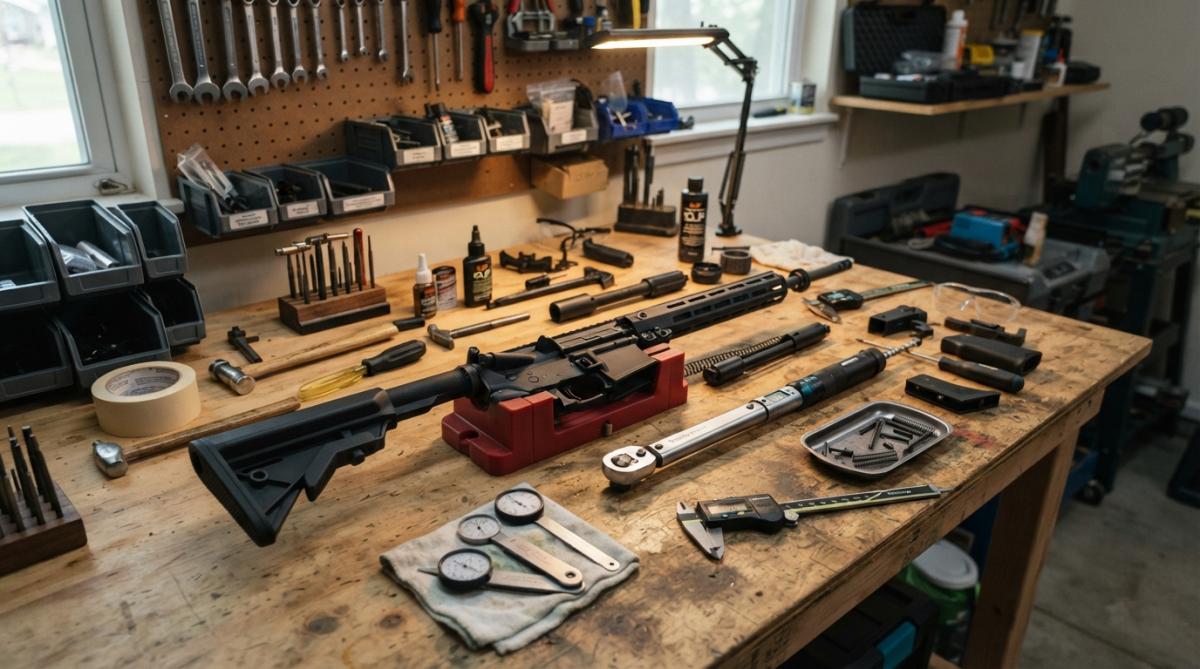
A quality torque wrench is essential. Barrel installation, action screws, and optics mounting all require specific torque values. Over-torquing damages threads and components. Under-torquing allows parts to shift, degrading accuracy. A click-style torque wrench in the 20-100 inch-pound range covers most firearm assembly tasks. Precision matters here, a standard adjustable wrench introduces guesswork.
Headspace gauges, calipers, and a bore alignment tool round out the core toolkit. The bore alignment tool verifies that your barrel is properly seated and aligned with your action. This prevents accuracy-robbing misalignment that’s invisible to the naked eye but immediately apparent at the range.
Many builders hesitate to invest in tools, viewing them as unnecessary expense. This is a false economy. A single mistake, improper headspace, misaligned barrel, incorrect torque, can render a build unsafe or inaccurate. The tools cost less than one quality match-grade barrel. Use them.
Firearm Component Compatibility Checklist
Component compatibility is where most home builders stumble. A lower receiver, upper assembly, magazine, stock, and trigger must all work together without binding or requiring modification. Incompatibility means either custom gunsmithing or scrapping components.
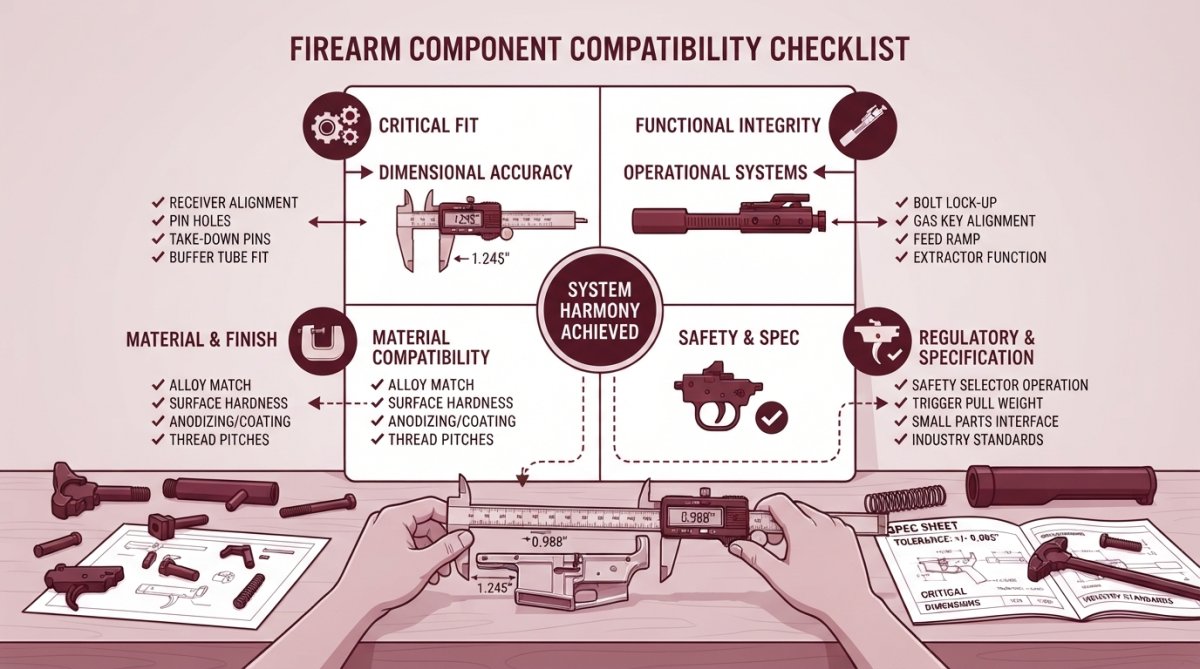
Start with the lower receiver. This is the legally regulated component in most jurisdictions, and it determines compatibility with everything else. Polymer Pew’s aluminum MKE lowers are tested for compatibility across multiple upper receiver types and trigger systems. This compatibility testing eliminates guesswork, you know the parts will fit before you order them.
Verify magazine compatibility next. Not all magazines fit all lower receivers. Feed lips, follower geometry, and catch engagement must align. Test fit your magazine before assembly. A magazine that doesn’t seat fully or engages inconsistently will cause malfunctions.
Trigger compatibility is critical. Your trigger group must fit within the trigger guard, engage the sear properly, and function without binding. Some triggers require trigger guard modifications. Quality manufacturers specify compatibility requirements. Polymer Pew’s super safety kits are engineered to drop into compatible lower receivers without modification.
Stock compatibility depends on buffer tube diameter and receiver extension type. A stock designed for a standard mil-spec tube won’t fit a commercial tube. Verify specifications before purchasing. This is a common source of frustration for first-time builders.
Optics mounting requires receiver-specific picatinny rails or dovetail mounts. Verify that your chosen optics interface with your action’s mounting system. A scope designed for Weaver rails won’t mount securely to picatinny rails without an adapter.
Create a compatibility matrix before ordering components. List each part you’re considering and verify cross-compatibility with every other part. This takes 30 minutes and prevents wasted money. Most manufacturers provide compatibility information on their websites or through customer service.
Best Budget Firearm Upgrade Kits Without Compromise
Budget builds don’t mean compromised performance if you prioritize correctly. A $200 upgrade kit that improves reliability and accuracy delivers better value than a $500 premium kit on a platform that doesn’t need it.
Identify your actual need first. Are you upgrading for accuracy, reliability, ergonomics, or durability? This determines which components deserve investment. A precision shooter needs a quality trigger and barrel. A tactical shooter needs reliability and ergonomics. A hunter needs durability and reliability.
Drop-in kits offer the best value for budget builders. These kits include pre-assembled components that require minimal gunsmithing. A trigger kit with safety and springs pre-installed, for example, eliminates assembly errors and reduces installation time. Polymer Pew’s budget-friendly drop-in kits maintain quality standards while reducing cost through efficient manufacturing and direct sales.
The mistake most budget builders make is buying the cheapest option across all categories. This creates a mismatched build where one weak component limits everything else. A $50 trigger on a $1,500 barrel platform is wasteful. A $200 trigger on a $100 barrel platform is equally wasteful. Balance your investment across components.
Prioritize components that directly impact your intended use. For a precision rifle, invest in the barrel and trigger. For a tactical platform, invest in reliability components and ergonomics. For a hunting rifle, invest in durability and reliability. Secondary components can be budget-friendly without consequence.
Test your build before investing in premium upgrades. A budget build that functions reliably tells you where to invest next. You might discover that your accuracy limitation is shooter skill, not equipment. This prevents expensive upgrades that don’t move the needle.
Maintenance, Reliability Testing, and Long-Term Performance
A high performance firearm build is only as reliable as your maintenance routine. Quality components fail faster under neglect than budget components under proper care.
Establish a cleaning schedule based on your shooting volume. A rifle fired 50 rounds weekly needs cleaning more frequently than one fired 50 rounds monthly. Fouling accumulates predictably, track your round count and clean accordingly. Most precision rifles benefit from cleaning every 500-1,000 rounds, depending on ammunition type and environmental conditions.
Reliability testing should happen before you trust your build for competition or hunting. Fire 200 rounds through your completed build, recording any malfunctions. Zero malfunctions indicates a reliable platform. One malfunction suggests an investigation, identify the cause and correct it. More than two malfunctions indicates a systemic problem requiring disassembly and inspection.
Document your testing results. Note ammunition type, environmental conditions, and any performance variations. This record helps you identify patterns. If your build malfunctions only with certain ammunition, you’ve identified a compatibility issue. If malfunctions increase over time, you’ve identified a maintenance problem.
Long-term reliability depends on component quality and proper installation. A quality trigger installed to specification will function reliably for thousands of rounds. A budget trigger installed carelessly will fail within hundreds. The installation method matters as much as the component itself.
Inspect critical components periodically. Remove your barrel and check for bore fouling. Verify that action screws remain tight. Confirm that your trigger mechanism moves freely. These inspections take 15 minutes and prevent failures that could occur at critical moments.
Building a high performance firearm requires balancing precision, reliability, and budget. The components you choose determine your accuracy ceiling and reliability floor. Polymer Pew delivers match-grade aluminum MKE lowers, specialized super safety kits, and flat triggers engineered for compatibility and reliability. These components eliminate guesswork and reduce installation complexity, letting you focus on building a platform that performs. Quality components installed properly create a firearm that shoots accurately and functions reliably for years. Get your Flatties here and start your high performance build today.
Frequently Asked Questions
What are the most important components for a high performance firearm build?
The action, barrel, trigger, and chassis system form the foundation. Match-grade barrels ensure velocity consistency and accuracy potential. A quality trigger with predictable pull weight directly impacts shooting mechanics. The action must be compatible with your platform, and the chassis system provides the ergonomics and stability needed for precision shooting. These four elements determine whether your build will deliver the performance you expect.
How do I ensure compatibility when selecting custom firearm parts?
Use a firearm component compatibility checklist before purchasing. Verify that your lower receiver matches your upper assembly platform. Check headspace with go/no-go gauges to confirm safe operation. Review torque specifications for all fasteners. Confirm bolt carrier group compatibility with your barrel and action. Test fit components before final assembly. Many builders skip this step and waste money on parts that don't work together, so take time to verify each piece fits your specific build.
What is the difference between budget and premium firearm upgrade kits?
Budget kits use anodized aluminum and stainless steel internals to reduce cost while maintaining durability. Premium kits often feature tighter tolerances, match-grade components, and enhanced materials. The real difference is in consistency and long-term reliability. A quality budget upgrade kit from a tested manufacturer will outperform a cheap knockoff, but premium kits typically offer better accuracy potential and longer service life. For competition shooting or precision work, premium components justify the cost. For recreational builds, best budget firearm upgrade kits deliver solid performance at lower investment.
How does trigger pull weight affect firearm performance?
Trigger pull weight directly influences your shooting mechanics and follow-through. A lighter, consistent pull weight reduces the force needed to break the shot, minimizing unwanted movement. Heavier triggers require more finger pressure, which can disrupt sight alignment. The key is consistency, your trigger must maintain the same pull weight shot after shot. Triggers that vary wildly waste ammunition and frustrate accuracy. For precision shooting, a 2-3 pound pull weight with predictable break is ideal. Always verify your trigger's specifications before purchase.
What tools are essential for a professional-grade firearm build?
You need a torque wrench set for proper fastener specifications, go/no-go gauges to verify headspace, a barrel vise or upper receiver block, and precision measurement tools. A brass punch set, hammer, and cleaning supplies are also necessary. Don't skip the headspace gauges, improper headspace causes dangerous malfunctions. A quality torque wrench prevents over-tightening, which can damage threads or cause binding issues. Essential gunsmithing tools for home builds don't have to be expensive, but they must be accurate and reliable.
How can I improve the reliability of a custom firearm build?
Start with component compatibility verification and proper assembly torque specifications. Use quality ammunition for testing, cheap rounds mask real reliability issues. Perform dry fire practice to identify binding or feeding problems before live fire. Inspect and clean the bolt carrier group, magazine, and feed path regularly. Test your build with multiple ammunition types and weights. Maintenance and long-term reliability depend on using the right components and following proper assembly procedures. Most reliability failures come from incompatible parts or improper assembly, not defective components.
Why should I choose tested components over unknown brands?
Tested components come with documented performance history and consistent quality control. Unknown brands often cut corners on materials, tolerances, or manufacturing processes. When you buy from manufacturers with proven track records, you're paying for reliability and compatibility assurance. Budget doesn't mean low quality, many tested manufacturers offer affordable options with verified performance. Polymer Pew's components are tested for variant compatibility and durability, so you know what you're getting before you build.
This article was written using GrandRanker