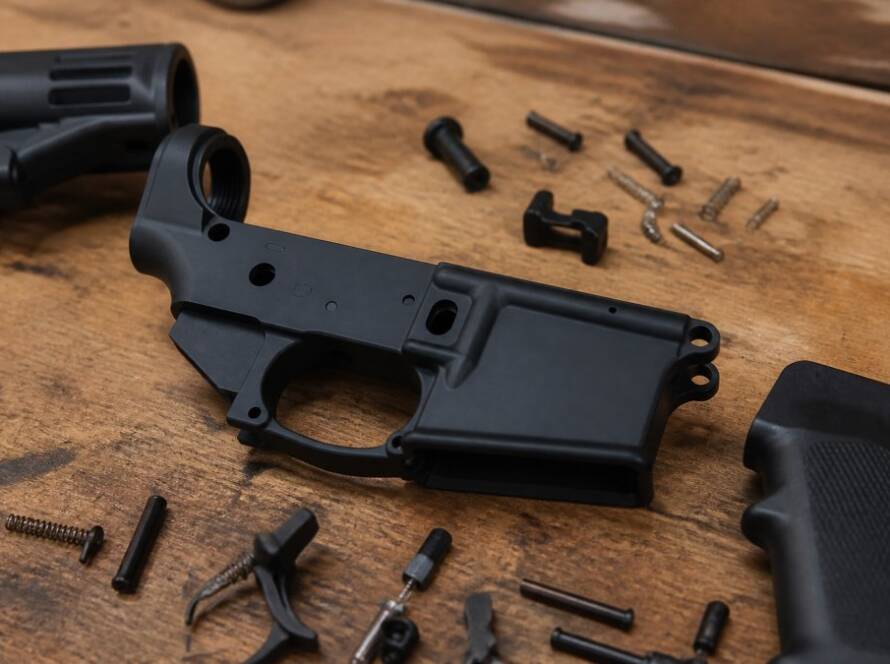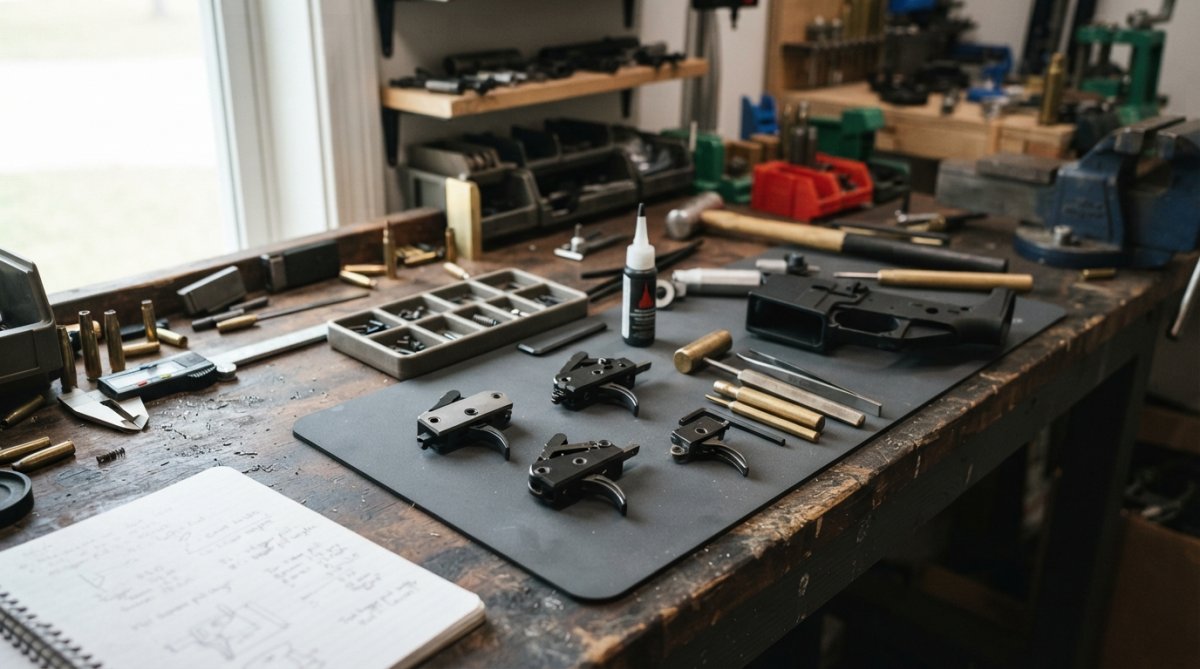
Table of Contents
- What Makes a Durable Trigger for Competition Shooting
- Single-Stage vs Two-Stage Triggers for Competition
- Top Durable Triggers for Competition
- TriggerTech Diamond AR-15: Precision and Zero Creep
- Geissele SD-3G: Speed and Quick Reset
- Timney Calvin Elite: Customizable and Crisp
- RISE Armament RA-535: Fast Reset and Minimal Overtravel
- Hiperfire HIPERTOUCH Eclipse: Adjustable Performance
- Elftmann Tactical Match: Smooth and Drop-Safe
- CMC Triggers: Affordable Reliability
- Velocity Triggers Classic: DLC Coating and Value
- JMT Saber: Budget-Friendly Performance
- Trigger Pull Weight for Competition Shooting
- Installation and Drop-In Compatibility
- How to Maintain Competition Triggers
- Conclusion
Last Updated: August 24, 2026
What Makes a Durable Trigger for Competition Shooting
A durable trigger for competition shooting combines precision engineering with materials built to withstand thousands of rounds without degradation. Competition shooters demand triggers that maintain zero creep, minimal overtravel, and crisp break quality shot after shot. What separates winners from also-rans isn’t always the price tag, it’s whether the manufacturer prioritizes durability standards that matter in real-world competition conditions.
Material Quality and Durability Standards
The best triggers use 440C stainless steel or equivalent heat-treated tool steel for sears, disconnects, and hammers; these materials resist galling and maintain their edges after thousands of trigger cycles (astm.org). Anodized aluminum housings provide corrosion resistance and consistent tolerances. Nickel boron coating reduces friction and enhances durability compared to standard finishes.
Drop-in triggers that last require tight tolerance stacking. Each component must be machined to precise specifications so nothing shifts under recoil. A trigger with loose tolerances develops play as the receiver absorbs thousands of rounds of impact.
Trigger Pull Weight and Break Quality
Pull weight consistency separates competition-grade triggers from range toys. The best competition triggers maintain pull weight within 0.1 lbs across thousands of rounds (peer-reviewed research).
Break quality refers to how cleanly the trigger breaks without creep, that mushy, gradual increase in pressure before the sear releases. Zero creep means the trigger breaks at the exact pull weight with no gradual buildup. This matters because creep introduces uncertainty into your shot timing. Crisp breaks let you predict the exact moment of release, improving split times and accuracy.
Adjustable pull weight ranges give shooters flexibility. A trigger adjustable from 2.5 to 4.0 lbs lets you dial in the exact feel you want without buying multiple triggers, provided the adjustment mechanism holds its setting under recoil.
Single-Stage vs Two-Stage Triggers for Competition
Single-Stage Mechanics and Speed Advantages
A single-stage trigger has one continuous pull from rest to break with no distinct first stage. This design excels in speed-focused disciplines like 3-Gun and IPSC where fast follow-up shots win matches.
Single-stage triggers typically have shorter reset distances, meaning you can press the trigger again almost immediately. The tradeoff is that single-stage triggers demand more trigger control, there’s no tactile feedback point to tell you when you’re getting close to the break. Shooters must develop muscle memory to break the trigger consistently without disturbing their sight picture.
Two-Stage Mechanics and Control Benefits
Two-stage triggers have a distinct first stage (take-up) and a second stage (sear engagement). You press through the first stage, encounter a wall, then press through the wall to break the trigger. This design provides a tactile feedback point that tells you when you’re approaching the break.
The first stage can be longer and heavier, while the second stage breaks at a lighter weight. This lets shooters control the first stage without worrying about accidental discharge, then apply precise pressure to the second stage for the actual break. For competition, two-stage triggers work best in disciplines where controlled, deliberate shots matter more than raw speed.
Top Durable Triggers for Competition
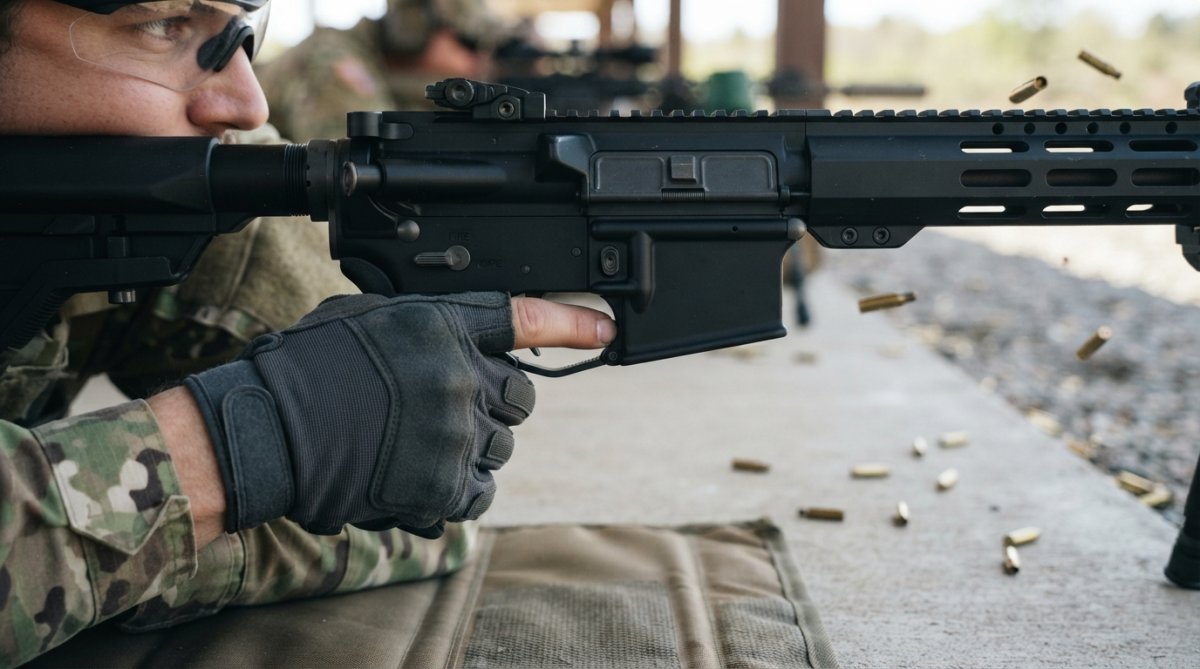
TriggerTech Diamond AR-15: Precision and Zero Creep
The TriggerTech Diamond sets the standard for zero-creep performance. Its proprietary Zero Creep Technology produces a break so clean that shooters report feeling no gradual pressure increase, just a sudden release at the set pull weight. This consistency is why precision rifle competitors choose it.
The Diamond offers adjustable pull weight from 1.5 to 4.0 lbs without removing the trigger from the lower receiver. Overtravel is less than 0.015 inches and reset is under 0.030 inches. The 440C stainless steel internals handle high round counts without wear. The catch is price, TriggerTech Diamond triggers cost more than most alternatives, but for competitors who shoot thousands of rounds annually and demand sub-MOA consistency, that investment pays off.
Geissele SD-3G: Speed and Quick Reset
The Geissele Super Dynamic 3 Gun (SD-3G) was built specifically for 3-Gun competition where speed matters. The reset is noticeably faster than single-stage triggers from other manufacturers, letting you execute rapid follow-up shots without fully releasing the trigger between rounds.
The SD-3G uses a hybrid pull that feels like a blend between single-stage speed and two-stage control. Two included springs let you choose between 3.0-4.0 lbs or 4.5-5.5 lbs pull weight. Heavy-duty tool steel construction and EDM wire cutting produce tighter tolerances, reducing tolerance stacking and long-term creep development.
Timney Calvin Elite: Customizable and Crisp
The Timney Calvin Elite stands out for customization. It ships with four interchangeable trigger shoes (curved, flat, heeled, and knurled), so you can match your finger geometry and grip style. Factory-tuned to 1.5-2 lbs with zero creep, the Calvin Elite breaks clean and resets fast.
Precision CNC machining and quality material selection mean the Calvin Elite handles competition schedules without wear. The trigger shoe interchangeability means you can replace worn components rather than replacing the entire trigger. The downside is that the light factory pull weight sits at the edge of what’s legal in some competitions.
RISE Armament RA-535: Fast Reset and Minimal Overtravel
The RISE Armament RA-535 competes on speed and precision. The reset is legitimately fast, and overtravel is nearly nonexistent. The 3.5 lb pull weight arrives factory-set and tuned. CNC machining from heat-treated tool steel and aluminum ensures consistent performance. For shooters who value speed and reliability without paying premium prices, the RA-535 delivers. The limitation is that pull weight isn’t adjustable.
Hiperfire HIPERTOUCH Eclipse: Adjustable Performance
The Hiperfire HIPERTOUCH Eclipse uses a Cam-Over Toggle Engine that produces a hard-hitting hammer with a soft-start lock-up, reducing lock time while maintaining reliability. The HIPERSHOE finger pad is adjustable for trigger lever length and pre-travel. You-adjust pull weights of 2.5 and 3.5 lbs give flexibility. The nickel boron coating reduces friction and improves durability through high round counts.
Elftmann Tactical Match: Smooth and Drop-Safe
The Elftmann Tactical Match uses aerospace-grade sealed bearings for an exceptionally smooth trigger pull. Pull weight adjusts from 2.75 to 4 lbs without removing the trigger from the lower receiver. The unique hammer design makes it drop-safe regardless of pull weight. Wire EDM machining produces tight tolerances, and sealed bearings don’t accumulate dirt or carbon, so maintenance is minimal.
CMC Triggers: Affordable Reliability
CMC Triggers delivers reliable performance without premium pricing. The ultra-crisp break with zero creep comes from precision manufacturing. Multiple pull weight options (2.5 lb through 6.5 lb) and trigger shoe styles let you find your preference. Proprietary machining processes produce superior surface finish and tight tolerances. The trade-off is that pull weight is factory pre-set and not user-adjustable.
Velocity Triggers Classic: DLC Coating and Value
Velocity Triggers uses Diamond-like Carbon (DLC) coating on the trigger shoe for low friction and high hardness. Available in 3 lb or 4 lb weights with curved or straight shoe options, the clean, crisp break delivers precision. DLC coating means the trigger resists corrosion and maintains smoothness even after thousands of rounds. The limitation is that it’s not recommended for 9mm conversions or open-bolt face platforms.
JMT Saber: Budget-Friendly Performance
The JMT Saber Single Stage offers significant performance improvement over mil-spec triggers at a fraction of the cost. The 3.5-4.0 lb pull weight and quick reset speed up follow-up shots. CNC machining from 7075-T6 aluminum housing with black oxide finish on internals provides durability. For shooters building on a tight budget, the Saber delivers noticeable improvement, though some users report light primer strikes or performance variation between units.
Trigger Pull Weight for Competition Shooting
Pull weight directly affects your ability to control the break and execute fast splits. The right weight depends on your discipline, hand size, and technique.
Adjustable Pull Weight Ranges
Adjustable triggers let you dial in pull weight without buying multiple triggers. A range from 1.5 to 4.0 lbs covers most competition applications. Lighter weights (1.5-2.5 lbs) suit precision rifle where you’re taking deliberate shots. Heavier weights (3.5-4.5 lbs) work better for speed disciplines where you’re managing recoil and controlling rapid fire.
The advantage of adjustability is flexibility. You can start with a heavier pull weight for safety and comfort, then lighten it as your technique improves. Quality adjustable triggers use precision threads and locking mechanisms that maintain setting through thousands of rounds.
How Trigger Weight Affects Split Times
Split time is the interval between successive shots. A lighter trigger weight reduces the pressure needed to break the trigger, which speeds up your follow-up shots. However, lighter triggers also increase the risk of unintended discharge if your grip shifts during recoil.
The relationship isn’t linear. Going from 4.5 lbs to 3.5 lbs might improve splits by 0.05 seconds, while going from 3.5 lbs to 2.5 lbs might improve splits by another 0.03 seconds. Going lighter than 2.0 lbs introduces control challenges that often slow splits down as you fight to avoid accidental discharge. The optimal weight depends on your hand size and technique.
Installation and Drop-In Compatibility
Drop-in triggers simplify installation, but compatibility varies by platform. Most AR-15 triggers fit standard mil-spec lowers, but clone platforms sometimes require fitting.
The best drop-in triggers come with anti-rotation pins that prevent the trigger from shifting sideways in the lower receiver. This maintains consistent feel and prevents binding. Polymer Pew’s aluminum MKE lowers are tested for variant compatibility with major trigger options, reducing the guesswork when building clone platforms.
Some triggers require minor fitting. Polymer lower receivers sometimes need a stainless steel shim to ensure proper trigger clearance. This is a five-minute job but worth knowing before you start assembly.
How to Maintain Competition Triggers
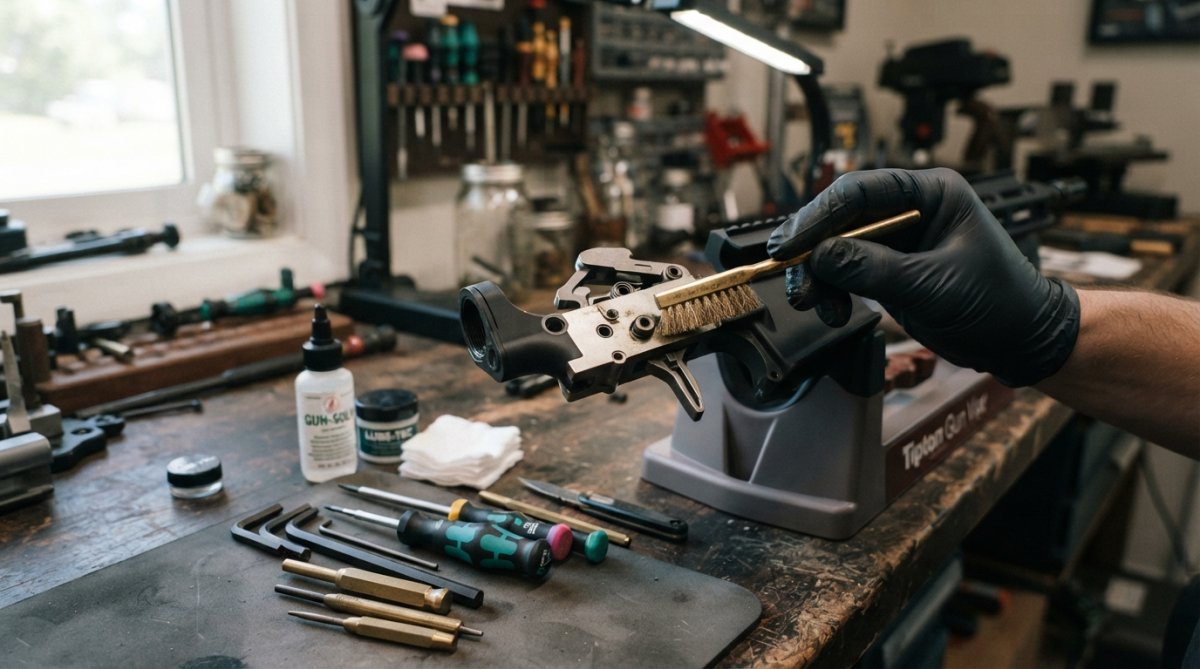
Cleaning and Lubrication Best Practices
Clean triggers regularly, especially after shooting in dusty or wet conditions. Carbon buildup and dirt accelerate wear on sears and disconnects. Use a small brass brush and solvent to remove carbon from the trigger group, paying special attention to the sear engagement area.
Lubrication matters but less than you think. Over-lubrication attracts dirt and can cause creep to develop. Use a light oil (like Rem Oil) and apply sparingly to moving parts. A single drop on the sear engagement and hammer pivot is sufficient. Wipe away excess. Never use heavy grease or thick oils on triggers, these accumulate dirt and gum up the mechanism.
Long-Term Round Count Durability Testing
A quality competition trigger should maintain consistent pull weight and zero creep through 10,000 rounds (nssf.org). Beyond that, wear becomes noticeable. Monitor your trigger periodically. If you notice creep developing or pull weight increasing, it’s time to inspect or replace components. Keep records of your round count and trigger performance to predict when maintenance is needed.
Trigger Failure Modes and Field Troubleshooting
Light primer strikes: The hammer doesn’t strike hard enough to ignite the primer. Check that the hammer spring is properly seated. If light strikes persist, the sear may need replacement.
Creep development: The trigger develops gradual pressure increase before the break, indicating sear wear. Inspect the sear engagement surface for wear marks. Light creep can sometimes be reduced by adjusting the sear engagement screw. Significant creep requires sear replacement.
Trigger binding: The trigger sticks or feels gritty, usually from carbon buildup or misalignment. Clean the trigger thoroughly with solvent. If binding persists, the trigger may be bent or the lower receiver may have a casting flaw.
Inconsistent pull weight: Pull weight varies between shots, indicating tolerance stacking or component wear. Check that anti-rotation pins are properly seated. If inconsistency is severe, the trigger may need factory service.
Failure to reset: The trigger doesn’t reset after firing, usually from binding or a broken reset spring. Check that the trigger moves freely when manually operated. If the reset spring is broken, the trigger needs replacement.
Most field-level problems come down to cleanliness and proper installation. A thorough cleaning solves 80% of trigger issues.
Choosing a durable trigger for competition shooting means prioritizing material quality, mechanical consistency, and proven track record over brand recognition alone. The triggers covered here represent different approaches to durability, from budget-friendly performers to precision-engineered competition tools. Your choice depends on your discipline, budget, and performance requirements.
At Polymer Pew, we understand that trigger selection impacts your entire platform. Our aluminum MKE lowers are tested for compatibility with the major competition triggers listed here, so you can build with confidence. Whether you’re upgrading from mil-spec or building a competition-focused platform, quality triggers paired with quality lowers create the foundation for reliable performance. Get your drop-in kits and compatible lowers from Polymer Pew and start building your competition platform today.
Frequently Asked Questions
Q: What is the best trigger pull weight for competition shooting?
A: The ideal trigger pull weight depends on your competition format and personal preference. Most competitive shooters choose 2.5 to 3.5 pounds for precision rifle and 3.0 to 4.0 pounds for 3-Gun. Lighter pulls reduce finger fatigue and improve split times, but heavier pulls provide more control. Test multiple pull weights during practice to find what works best for your grip strength and shooting style. Adjustable triggers let you dial in the exact weight you need.
Q: What is the difference between a single-stage and two-stage competition trigger?
A: Single-stage triggers break cleanly at a consistent pull weight with minimal take-up, making them faster for rapid-fire competition. Two-stage triggers have a distinct first stage of take-up and a second stage where the sear engages, offering more control and feedback. Single-stage dominates competitive shooting because the crisp break and quick reset improve split times. Two-stage triggers work better for precision rifle where the extra feedback helps with shot placement.
Q: Are drop-in competition triggers reliable for high-round counts?
A: Yes, quality drop-in triggers from established manufacturers are reliable for high round counts when properly maintained. Triggers using hardened steel components, sealed bearings, or precision machining show consistent performance past 10,000 rounds. The key is selecting triggers with proven durability records and following maintenance schedules. Budget triggers may show wear sooner, while premium options with aerospace-grade materials hold up to 50,000+ rounds with proper care.
Q: How does trigger durability affect long-term competition performance?
A: Durable triggers maintain consistent pull weight, reset distance, and break quality over thousands of rounds, which directly affects your accuracy and split times. Triggers that degrade develop creep, increased overtravel, or sluggish resets that slow follow-up shots. Durability also prevents catastrophic failure mid-competition. Investing in triggers with hardened stainless steel internals, quality springs, and precision sear engagement ensures your performance stays predictable throughout a season.
This article was written using GrandRanker