Table of Contents
- The Short Answer: Trigger Weight Alone Doesn’t Make a Glock Safer
- How Glock Trigger Pull Weight Standards Work
- Mechanical Safety vs. Trigger Weight: What Actually Stops Accidental Discharge
- Stress, Sympathetic Contraction, and the Human Factor
- How to Prevent Mechanical Binding in Super Safety Kits
- Best Practices for Firearm Trigger Maintenance
- Trigger Weight vs. Accuracy: The Trade-Off You Need to Understand
- Aftermarket Triggers: When Heavier Isn’t Better
- Frequently Asked Questions
Last Updated: September 3, 2026
The Short Answer: Trigger Weight Alone Doesn’t Make a Glock Safer
Is a heavier Glock trigger safer? No. Trigger weight is secondary to mechanical design: the firing pin block, sear engagement, and trigger bar working together as an integrated system. A Glock’s safety architecture relies on three independent mechanical safeties, not trigger weight. Increasing trigger poundage won’t compensate for poor training, negligent handling, or mechanical failure.
The real issue is human factors. Stress-induced response, sympathetic contraction, and operator error account for most accidental discharges. A heavier trigger doesn’t solve these problems; under high stress, it can actually increase risk by demanding more finger pressure and introducing more variables into the firing sequence.
This guide covers what actually matters: mechanical safety systems, trigger discipline, and practical maintenance. We’ll break down the engineering, address common misconceptions, and show you how to evaluate trigger modifications without sacrificing reliability or safety.
How Glock Trigger Pull Weight Standards Work
Factory Glock triggers have a standard pull weight between 5.5 and 6.5 pounds, depending on generation and model (glock.com). This range balances safety with shootability, not to maximize safety, but to meet a middle ground between ease of operation and accidental discharge prevention.
When you modify a trigger or install an aftermarket component, you’re changing a variable already optimized by the manufacturer. Lighter triggers (3.5 to 4.5 pounds) are common in competition; heavier triggers (7 to 8 pounds) are sometimes requested by shooters who believe extra resistance equals extra safety. Neither assumption is correct.
The tactile feedback and reset matter more than raw poundage. A trigger with consistent pre-travel, predictable sear engagement, and reliable reset will perform better than a heavier trigger with mushy feedback. Shooters using heavier triggers often compensate by pressing harder, introducing sympathetic contraction, the tendency to tighten other fingers when squeezing the trigger. This is a primary cause of negligent discharge in high-stress situations.
Aftermarket modifications change these specifications. Some kits reduce trigger weight while improving reset; others add weight but change spring rate for better tactile feedback. The question isn’t whether heavier is safer, but whether the modification maintains mechanical safety while improving control. Polymer Pew’s flat triggers and safety kits preserve the three-safety architecture while offering improved feel and reliability.
Mechanical Safety vs. Trigger Weight: What Actually Stops Accidental Discharge
Real protection against accidental discharge comes from mechanical design, not trigger poundage. A Glock’s firing pin block is the primary safety device, a spring-loaded mechanism that sits between the firing pin and hammer. When the trigger isn’t pressed, the firing pin block is raised, physically preventing the firing pin from striking the primer (peer-reviewed research). Trigger weight has no influence on this system.
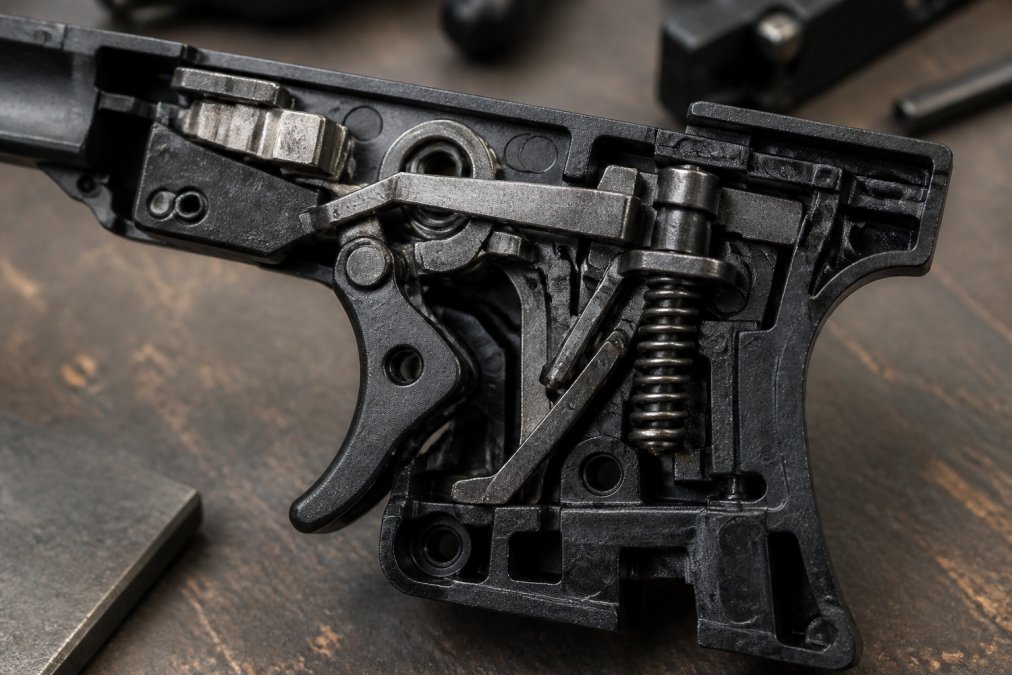
The Three Internal Safeties in a Glock
Every Glock has three redundant mechanical safeties.
The firing pin block is the first line of defense. It physically blocks the firing pin from moving forward unless the trigger is fully depressed. This passive safety requires no user action. Even if the gun is dropped, the firing pin cannot strike the primer.
The sear engagement is the second safety. The sear is a small notch on the trigger bar that catches on the hammer. When the trigger is pressed, the sear disengages and allows the hammer to fall. A heavier trigger cannot prevent sear binding, only proper mechanical design and maintenance can.
The cruciform safety is the third layer. This small cross-shaped lever sits on top of the trigger. When you press the trigger, the cruciform moves inward, allowing the firing pin block to drop. If your finger isn’t on the trigger, the cruciform stays in place and the firing pin block stays raised.
These three systems work together and none depend on trigger weight. A Glock with a 3-pound trigger and one with an 8-pound trigger have identical mechanical safety architecture. Trigger weight changes how much finger pressure is required, but not how these systems operate.
Why Trigger Weight Is Secondary to Mechanical Design
Trigger weight affects shooter control and consistency. A lighter trigger requires less finger movement, improving accuracy in controlled environments. A heavier trigger requires more deliberate action, which some believe improves safety. But this is a false correlation.
What matters far more is mechanical friction and spring tension. A trigger with strong, consistent spring rate and smooth sear interface performs reliably regardless of poundage. A trigger with worn springs or damaged sear is unreliable whether light or heavy. Polymer Pew’s super safety kits focus on these mechanical factors, improving spring rate, ensuring proper sear engagement, and preventing binding, rather than simply adding weight.
Stress, Sympathetic Contraction, and the Human Factor
Most accidental discharges happen under stress, not during routine handling. When adrenaline spikes, fine motor control deteriorates. Shooters unconsciously tighten their grip, causing sympathetic contraction in the trigger finger. A heavier trigger makes this worse because it requires more finger pressure to begin with.
Research into defensive carry incidents shows shooters under extreme stress often have no conscious awareness of their trigger finger (peer-reviewed research). This target fixation makes trigger weight irrelevant because the shooter isn’t consciously managing finger pressure, they’re reacting. A heavier trigger doesn’t prevent this response; only training and muscle memory do.
Administrative handling (cleaning, loading, unloading) happens in calm conditions. Tactical application happens under threat. A heavier trigger might feel safer during administrative handling but becomes a liability in tactical application because it demands more finger pressure when fine motor control is already compromised.
Trigger discipline, keeping your finger off the trigger until you’ve decided to fire, is the actual safety mechanism. No trigger weight substitutes for this training.
How to Prevent Mechanical Binding in Super Safety Kits
Mechanical binding occurs when internal components don’t move freely through their full range of motion. This can prevent proper trigger reset or, in extreme cases, prevent the trigger from functioning at all.
Binding usually results from tolerance stack-up. When you install a new trigger bar or sear into a lower receiver, small manufacturing variations add up. The trigger bar might be slightly thicker than factory. The sear might sit at a different angle. The firing pin block might lack clearance.
To prevent binding, start with test-fitting. Install new components without the hammer or firing pin assembly. Manually cycle the trigger bar through its full range of motion. It should move smoothly from rest to full trigger press to reset. If you feel resistance or grinding, stop immediately. concealed carry holster setup.
Common causes of binding include improper sear engagement angle, trigger bar thickness variation, firing pin block clearance issues, and lower receiver machining differences. Polymer Pew’s super safety kits are designed for standard lower receivers, but clone compatibility varies. Before installation, verify your lower receiver is within tolerance.
If binding occurs after installation, light binding sometimes clears after 50-100 dry cycles. Persistent binding requires disassembly and inspection. You may need to carefully hone the trigger bar, adjust sear engagement, or verify firing pin block clearance.
Best Practices for Firearm Trigger Maintenance
Clean your trigger assembly regularly. Carbon buildup reduces spring tension and increases friction. Disassemble the trigger group, wipe down the trigger bar, sear, and springs with a clean cloth, and apply light lubricant. Don’t over-lubricate; excess oil attracts dirt.
Inspect the sear interface regularly. The sear should have a clean, sharp edge where it engages the hammer. If it looks rounded or worn, replacement is necessary. A worn sear is the most common cause of unreliable trigger function.
Check spring tension annually. Springs weaken over time, especially if stored cocked. A weak spring produces mushy trigger feel and inconsistent reset. If the trigger feels softer or slower to reset, the spring likely needs replacement.
Verify cruciform safety function. Press the cruciform and ensure it moves smoothly. If it sticks, disassemble and clean it. Cruciform problems usually result from carbon buildup or dried lubricant.
Store your firearm unloaded with the hammer down. Don’t store cocked or under tension. This preserves spring tension and prevents premature wear.
Trigger Weight vs. Accuracy: The Trade-Off You Need to Understand
Lighter triggers generally improve accuracy in controlled shooting. With less finger pressure required, there’s less chance of disturbing the sight picture. This is why competition shooters often run 2.5 to 4-pound triggers. In a match environment with time to aim, a lighter trigger delivers better results.
But accuracy is contextual. In a defensive scenario, where you’re moving and reacting under stress, a lighter trigger becomes a liability. The fine motor control required is lost under stress. A heavier trigger forces deliberate action, which some argue improves safety in tactical contexts.
The trade-off isn’t binary. A 5 to 6-pound trigger with excellent reset and consistent break point outperforms both a poorly-designed 3-pound trigger and a poorly-designed 8-pound trigger. Mechanism quality matters more than raw weight.
For most shooters, a factory Glock trigger (5.5 to 6.5 pounds) is the right compromise. For competition, go lighter. For defensive carry, keep it stock or slightly heavier. Aftermarket triggers from quality manufacturers like Polymer Pew improve reset and tactile feedback without sacrificing safety. The goal is optimizing the trigger for your specific use case while maintaining mechanical reliability.
Aftermarket Triggers: When Heavier Isn’t Better
Aftermarket triggers fall into two categories: performance upgrades that improve consistency and feel, and novelty modifications that chase extreme specifications without practical benefit.
Performance upgrades focus on reset, sear engagement, and spring rate. A quality aftermarket trigger has faster, more predictable reset than factory. It has a cleaner break point with less pre-travel and over-travel. These improvements translate to better accuracy and reliability regardless of weight.
Novelty modifications chase extremes. Ultra-light triggers (under 2 pounds) offer no practical advantage for most shooters and create real safety risks. Ultra-heavy triggers (over 8 pounds) don’t improve safety; they just make the gun harder to use.
The best aftermarket triggers balance weight, reset, and feel. Polymer Pew’s flat triggers offer improved reset and tactile feedback compared to factory triggers while maintaining reasonable weight. The flat design provides better ergonomics and control without requiring extreme poundage.
When evaluating an aftermarket trigger, ask: Does it improve reset? Does it have a cleaner break point? Does it work reliably with your lower receiver? Does the weight match your intended use case? If yes to all four, it’s a solid upgrade. If marketed primarily on extreme weight, skip it.
Installation matters as much as the trigger itself. A quality trigger installed poorly performs worse than a factory trigger installed correctly. Take time during installation to ensure smooth operation. Test-fit before final assembly. Verify all three mechanical safeties function properly after installation.
Trigger weight is a detail, not a solution. The real question isn’t whether a heavier trigger is safer, but whether your firearm’s mechanical safeties function properly and whether you have the training to use it responsibly. Polymer Pew’s components prioritize mechanical safety. Our super safety kits and flat triggers improve reliability and control while maintaining the three-safety architecture that actually protects you. Focus on reset, sear engagement, and compatibility. Get your precision-engineered triggers and safety kits from Polymer Pew and build with confidence.
Frequently Asked Questions
What is the ideal trigger pull weight for a Glock?
Factory Glock triggers are engineered to approximately 5.5 pounds pull weight, with a range of 5-6 pounds across production models. This standard balances shootability with safety margin. Tactical applications sometimes call for lighter triggers (4-4.5 pounds) for competition, while administrative or defensive carry often benefits from factory specs or heavier pulls (6+ pounds). The ‘ideal’ weight depends on your use case and training level, not on whether heavier is universally safer.
Does a heavier trigger pull prevent accidental discharges?
Not reliably. While a heavier trigger requires more finger pressure, accidental discharge typically results from poor trigger discipline, stress-induced sympathetic contraction, or mechanical failure, not insufficient trigger weight. Glocks already have three mechanical safeties (trigger safety, firing pin block, drop safety) that prevent discharge without relying on pull weight. Training and muzzle awareness are far more effective at preventing negligent discharge than trigger weight alone.
What role does the internal safety system play in Glock reliability?
Glock’s internal safety design, the cruciform firing pin block, sear engagement geometry, and drop safety, are the primary mechanisms preventing accidental discharge. These mechanical features work independently of trigger pull weight. A Glock will not fire if dropped, even with a light trigger installed, because the firing pin block prevents the pin from moving forward unless the trigger is fully pressed. This is why modern Glocks are considered reliable regardless of aftermarket trigger modifications.
How do I prevent mechanical binding in super safety kits during installation?
Mechanical binding occurs when components don’t seat properly or when spring tension is misaligned. To prevent binding: (1) test fit all parts before final assembly, (2) ensure the sear interface has consistent contact with the trigger bar, (3) verify spring rate matches your trigger assembly, and (4) check for burrs or debris in the trigger channel. If you’re installing a drop-in kit, confirm compatibility with your specific lower receiver. Polymer Pew’s tested kits are designed for drop-in compatibility, but always perform a function check after installation before live fire.
This article was written using GrandRanker