Table of Contents
- What a Forced Reset Trigger Actually Does
- Forced Reset Trigger vs. Binary Trigger: Key Differences
- The ATF Forced Reset Trigger Ruling and Legal Risks
- Reliability and Stress-Fire Performance for Defensive Use
- Legal Liability and Insurance in a Defensive Shooting
- Best Home Defense Trigger Upgrades: FRT vs. Drop-In Triggers
- TriggerTech vs. Apex Tactical: Reliable Alternatives
- The Verdict: Is a Forced Reset Trigger Worth It?
- Frequently Asked Questions
Last Updated: September 8, 2026
A forced reset trigger is a firearm modification that uses the weapon’s recoil energy to mechanically push the trigger forward after each shot, enabling rapid follow-up shots without converting the rifle to full-auto (atf.gov). For home defense, the question of whether a forced reset trigger is worth it comes down to a trade-off between faster follow-up speed and significant legal, mechanical, and tactical risks. At Polymer Pew, we are direct about the pros and cons rather than just listing specs. Most shooters are better served by a high-quality drop-in trigger, but the full picture requires understanding what an FRT actually changes in the gun and in your legal exposure. Below, we break down the mechanics, the ATF forced reset trigger ruling, and why reliability under stress is the deciding factor for serious use.
What a Forced Reset Trigger Actually Does
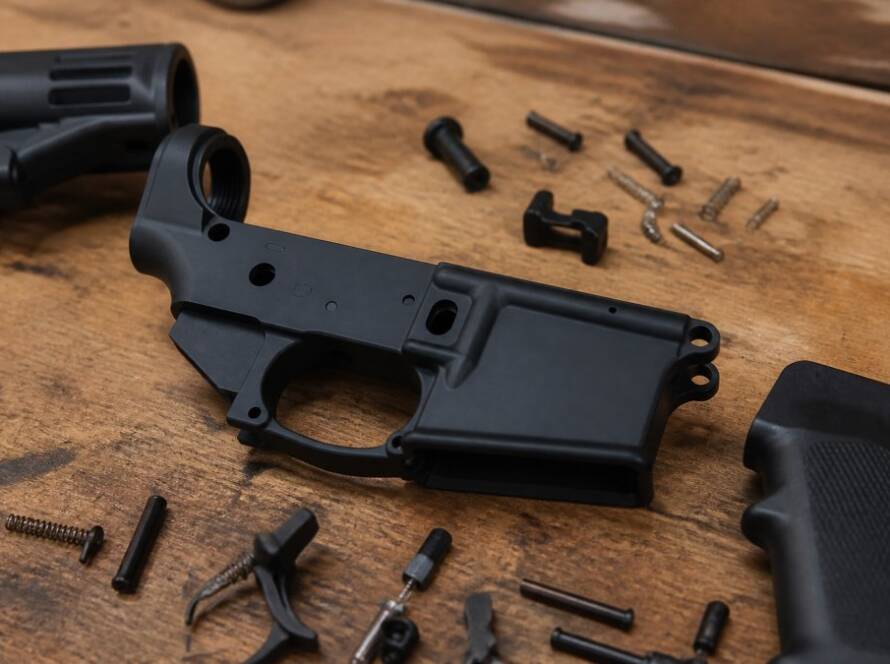
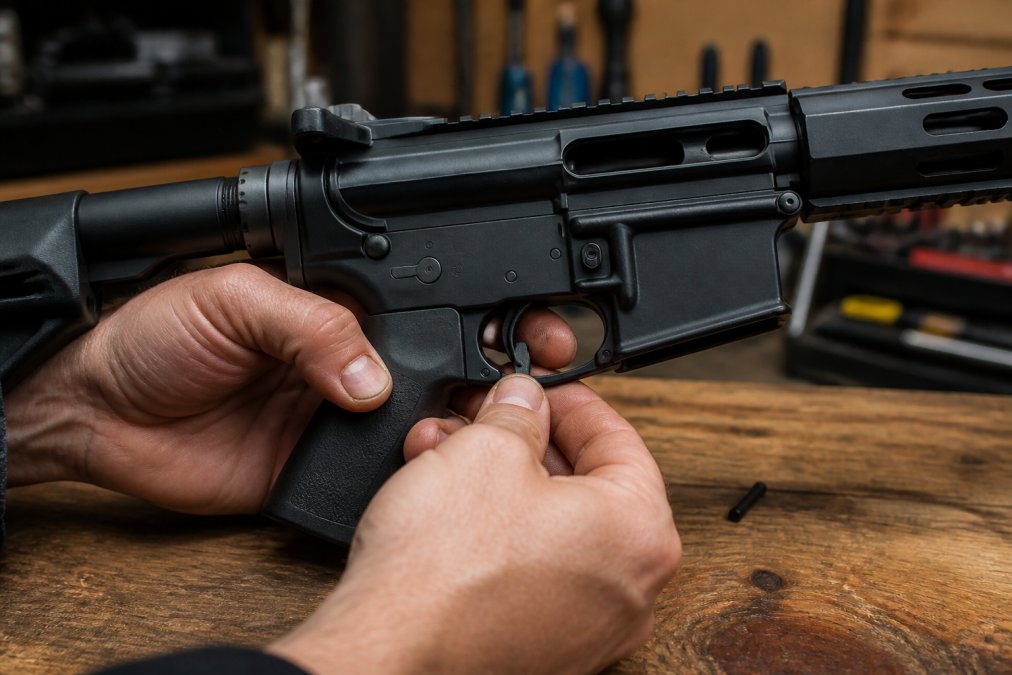
A forced reset trigger (FRT) is a semi-automatic trigger mechanism that mechanically pushes the trigger shoe forward after the hammer falls, using the bolt carrier group’s cycling motion. This mechanical reset lets the shooter hold the trigger down while the rifle fires, resets, and fires again as fast as the action cycles, without the gun being classified as a machine gun under current law.
The practical effect is a rate of fire much higher than a standard trigger pull allows. The shooter does not need to release and re-press the trigger manually; the mechanism does that work. What most guides miss is that this changes your trigger discipline fundamentally. With a mil-spec trigger, a negligent discharge usually means you pulled when you should not have. With an FRT, holding the trigger through a full cycle becomes the operating method, which blurs the line between intentional fire and loss of control.
Forced Reset Trigger vs. Binary Trigger: Key Differences
The difference between an FRT and a binary trigger comes down to when the second shot fires. A binary trigger fires one round on the pull and one round on the release of the trigger (atf.gov). A forced reset trigger fires one round per complete cycling of the bolt while the trigger remains depressed, with no shot fired on the release.
| Feature | Forced Reset Trigger | Binary Trigger |
|---|---|---|
| Firing method | One shot per bolt cycle | One on pull, one on release |
| Trigger hold | Hold and let it reset | Must release for second shot |
| Follow-up speed | Faster, continuous cycling | Slower, deliberate release |
| Mechanical complexity | High, many moving parts | Moderate |
| Legal scrutiny | High after ATF rulemaking | High in several states |
From a mechanical standpoint, the FRT is more efficient for pure speed. But that speed comes at a cost: the shooter has less control over when each round leaves the gun. For a defensive purpose, where every shot must be accounted for, a binary trigger at least gives you a defined break point on the release.
The ATF Forced Reset Trigger Ruling and Legal Risks
The legal landscape for forced reset triggers changed dramatically in recent years. The Bureau of Alcohol, Tobacco, Firearms and Explosives classification of forced reset triggers has actively pursued rulemaking to classify certain FRT designs as machine guns under the statutory definition, arguing that they fire more than one shot per function of the trigger.
The ATF forced reset trigger ruling creates real risk for owners. Federal court decisions on the matter have been mixed, and the classification can change based on the specific design and how it is installed. What this means for a home defense rifle is straightforward: if your defensive firearm is ever examined after a shooting, the presence of an FRT invites scrutiny that a standard trigger does not.
If you use an FRT in a defensive shooting, prosecutors can argue the device shows an intent to fire rapidly rather than to stop a threat. Even if the device is legal in your state, that argument can follow you into court and influence a jury.
Reliability and Stress-Fire Performance for Defensive Use
Most discussions of FRTs focus on mechanical function at a bench rest, but a home defense scenario is a different environment entirely. The question isn’t whether an FRT can fire fast on a calm range, it’s whether it will function predictably when your heart rate is elevated, your grip is compromised, and your cognitive load is maxed out. This is a gap in nearly every ranking article, which tend to ignore the physiological realities of a defensive shooting.
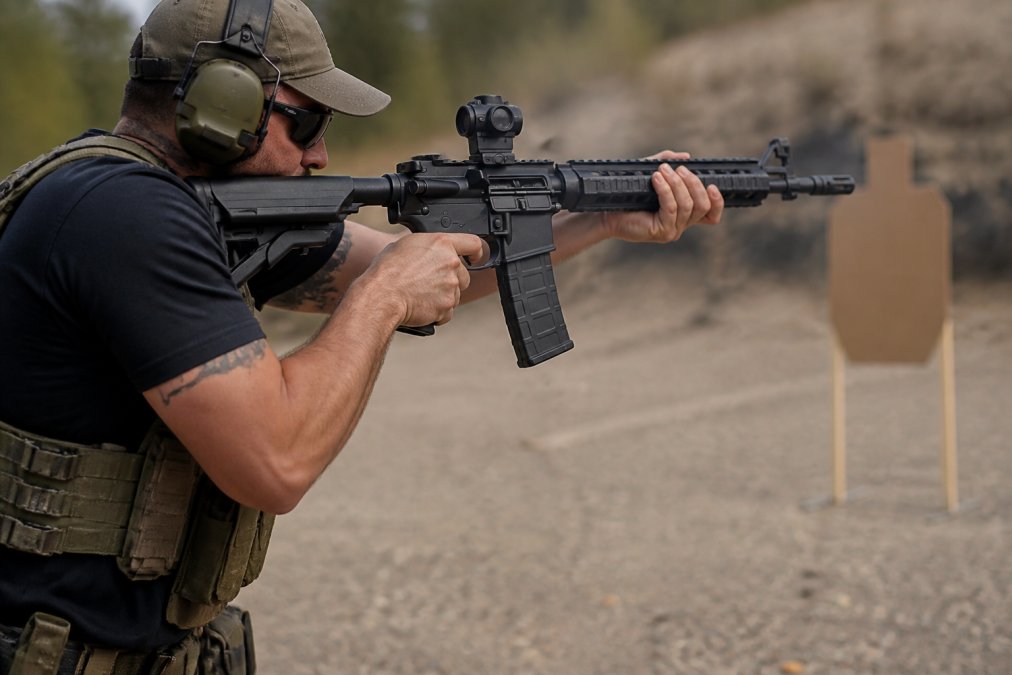
Under stress, the body’s sympathetic nervous system response degrades fine motor skills. Trigger control, which relies on precise, isolated finger movement, is one of the first things to suffer. A standard trigger with a consistent pull weight of 4.5 to 5.5 pounds gives you a predictable break point that your muscle memory can rely on. An FRT, by contrast, requires you to maintain a constant rearward pressure on the trigger while the mechanism cycles. If your grip tightens involuntarily, a common response under threat, you may inadvertently increase pressure on the trigger shoe, which can cause the mechanism to bind or short-stroke.
Short-stroking is a specific failure mode where the bolt carrier group does not travel far enough rearward to fully cock the hammer or reset the trigger. This can happen with an FRT when the shooter’s grip pressure or the rifle’s recoil impulse changes the timing of the trigger reset. The result is a dead trigger at the worst possible moment. This is not a theoretical concern; it is a known issue discussed in FRT owner communities, where users report that ammunition selection, buffer weight, and gas system tuning are critical to achieving reliable cycling. Defensive ammunition, which is often loaded to different pressure curves than range ammo, can alter the bolt’s travel speed and disrupt the FRT’s delicate timing.
Consider the mechanics: an FRT relies on the bolt carrier group’s forward motion to push the trigger forward. If the rifle is slightly over-gassed or under-buffered, the bolt may return to battery faster than the trigger mechanism can reset, causing a misfire or a double-fire. Conversely, if the rifle is under-gassed, the bolt may not travel far enough to reset the trigger at all. A mil-spec trigger, or a quality drop-in unit, does not have this dependency. It resets based on the hammer’s position, which is a simpler, more forgiving system.
In a defensive scenario, you are not going to be thinking about your rifle’s gas system or buffer weight. You will be focused on the threat. If your FRT requires a specific ammunition type or a tuned action to run reliably, you are introducing a variable that could fail under the exact conditions where you need it most.
There is also the question of training. Most defensive shooters train with a standard trigger, building muscle memory for a specific pull weight and reset. Switching to an FRT for home defense means retraining your entire trigger manipulation. Under stress, you will revert to your most practiced behavior. If that behavior is a standard trigger press, you may find yourself releasing the trigger after each shot with an FRT, which defeats its purpose and can cause a negligent discharge if the mechanism resets while your finger is still in the trigger guard.
A common pattern among defensive firearms instructors is to emphasize consistency over speed. A trigger that breaks at the same point, with the same weight, every single time, is more valuable than one that fires faster but less predictably. The stress-fire data we do have, from law enforcement and military studies on combat marksmanship, consistently shows that accuracy degrades under stress, and that shooters who rely on complex mechanical processes are more prone to errors. An FRT adds a layer of mechanical complexity that works against this principle. home security hardware.
For a home defense rifle, the reliability bar is absolute: it must go bang every time you pull the trigger, and it must stop when you stop pulling. An FRT, with its dependence on bolt timing and shooter grip, does not meet that bar for most users. A quality drop-in trigger provides a consistent, predictable pull that works with your body’s stress response, not against it.
Legal Liability and Insurance in a Defensive Shooting
A defensive shooting is a legal event as much as a tactical one. The firearm used becomes evidence, and every modification is examined for what it says about the shooter’s intent and mindset. An FRT, with its association with high-speed fire and its contested legal status, creates an uphill argument that a standard trigger does not.
Insurance implications compound the problem. Many self-defense insurance policies have terms that exclude coverage if the firearm was modified in a way that violates federal or state law, or if the device could be characterized as converting the weapon to automatic fire. If the ATF forced reset trigger ruling applies to your specific device, your coverage could be voided at the exact moment you need it most.
For a rifle whose only job is protecting your family, the legal risk of an FRT outweighs the tactical benefit. A clean, reliable trigger you have trained with is the defensible choice.
Best Home Defense Trigger Upgrades: FRT vs. Drop-In Triggers
The best home defense trigger upgrades prioritize a consistent pull weight, a short and crisp break, and a positive reset. Drop-in triggers deliver these qualities without the legal exposure or mechanical complexity of an FRT.
A quality drop-in trigger gives you a trigger pull in the 3.5 to 4.5 pound range, which is light enough for accurate rapid fire but heavy enough to prevent accidental discharges. The reset is short and tactile, letting you fire follow-up shots quickly without the mechanism doing the work for you. This is a practical choice for shooters of any skill level who want speed with control.
TriggerTech vs. Apex Tactical: Reliable Alternatives
When comparing triggertech vs apex tactical, both manufacturers produce drop-in triggers that outperform an FRT for defensive use. TriggerTech uses a frictionless release mechanism that delivers a consistent pull weight with no creep, which is valuable for shooters who need predictable performance under stress. Apex Tactical is known for its duty-grade triggers that maintain reliability through extensive round counts.
For a home defense rifle, the choice between these two comes down to preference. TriggerTech excels in competition-style precision, while Apex Tactical builds triggers tested for hard use. Both avoid the legal questions surrounding an FRT while delivering faster follow-up shots than a mil-spec trigger. At Polymer Pew, we offer drop-in kits and flat triggers built with anodized aluminum housings and stainless steel internals, designed for compatibility with various firearm clones and tested for consistent performance.
The Verdict: Is a Forced Reset Trigger Worth It?
A forced reset trigger is not worth it for home defense. The mechanical speed advantage does not justify the legal liability, the reliability concerns, or the training burden it places on the shooter.
For range use and competition, an FRT can be an interesting piece of engineering to explore where legal. For a defensive purpose, the calculus is different. Your rifle needs to work every time, under extreme stress, and it needs to be defensible in court if you ever use it. A drop-in trigger from a reputable manufacturer delivers the follow-up speed you need without those risks.
If you already own an FRT and are considering it for home defense, train with a standard trigger for defensive drills and reserve the FRT for the range. Your muscle memory should match what you would grab in the dark.
The most important upgrade for a home defense rifle is not the fastest trigger, but the one you have trained with until the pull, break, and reset are automatic. That reliability, both mechanical and legal, is what matters when the stakes are highest.
Frequently Asked Questions
Are forced reset triggers worth it for home defense?
For most people, no. A forced reset trigger is a range toy that increases your rate of fire, but it does little to improve practical accuracy under stress. For home defense, a clean, reliable trigger with a consistent pull weight is more valuable. You also face significant legal and financial exposure if you ever use an FRT in a defensive shooting, which makes it a poor trade-off for a serious use rifle.
What is the ATF’s current stance on forced reset triggers?
The ATF has reversed its position on forced reset triggers. In 2021, they classified them as non-machine guns. In 2022, they reversed that decision, reclassifying FRTs as machine guns. This means owning one can put you in legal jeopardy under federal law. Court challenges are ongoing, but the current guidance is that FRTs are restricted items. Do not buy one without understanding this legal risk.
Can a forced reset trigger cause a negligent discharge?
Yes, the risk is higher. An FRT relies on the shooter’s technique to reset the trigger, which changes your trigger discipline. Under stress, you may not fully release the trigger, causing an unintentional second shot. This is why proper training is critical. For a home defense scenario, a standard trigger with a predictable break is safer and easier to control when your adrenaline is spiking.
How does a forced reset trigger differ from a standard semi-automatic trigger?
A standard trigger uses a spring to push the trigger forward after each shot. A forced reset trigger uses the bolt carrier’s forward movement to mechanically push the trigger forward. This allows for a faster follow-up shot because the trigger resets earlier in the cycling process. The result is a higher rate of fire, but it demands a deliberate release and press technique that is difficult to master under stress.
Choosing a trigger for a defensive rifle means balancing speed against accountability. A forced reset trigger shifts that balance too far toward risk. Polymer Pew builds drop-in trigger kits and components with hardened stainless steel and anodized aluminum construction, tested for compatibility and consistent pull weight, so you get the performance you need without the legal baggage. Get your Flatties here and build a rifle you can trust with your life.