Table of Contents
- Flat Face vs Curved AR Triggers: Quick Comparison
- How Trigger Geometry and use Affect Your Pull
- Single Stage vs Two Stage Triggers: Which Pairs Best With a Flat Face?
- Trigger Pull Weight Explained: What Flat Faces Can and Cannot Change
- Best Drop-In AR-15 Triggers With Flat Faces
- When a Flat Face AR Trigger Wins: Precision, Speed, and Hand Size
- Safety and Dry Fire Training With Flat Triggers
- Frequently Asked Questions
Last Updated: September 14, 2026
Flat Face vs Curved AR Triggers: Quick Comparison
Walk into any gun shop and you’ll hear the same argument: is a flat face AR trigger better, or is it just hype? A flat face AR trigger is a trigger with a straight, vertical shoe that presents a consistent surface to your finger, while a curved trigger follows the traditional bowed profile found on mil-spec rifles. This guide from Polymer Pew breaks down the geometry, the mechanics, and the practical trade-offs so you can decide for your own build.
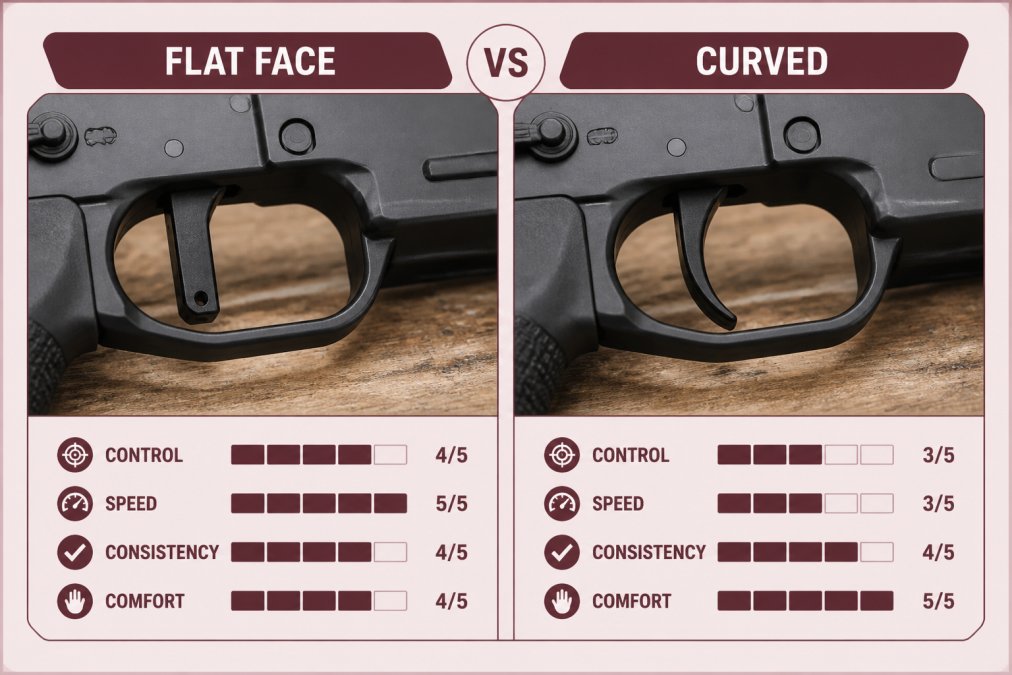
Here’s the honest answer up front: flat faces win for precision and consistency, curved faces win for familiarity and gloved use. Most shooters who compete or train seriously end up on a flat shoe.
| Factor | Flat Face | Curved Face |
|---|---|---|
| Finger placement | Consistent, repeatable | Varies by finger size |
| Pull feel | Linear, straight rearward | Slight arc |
| Best for | Precision, rapid fire | General use, gloves |
| Learning curve | Short adjustment period | None |
| Common in | Match and race guns | Mil-spec rifles |
How Trigger Geometry and use Affect Your Pull
Trigger geometry determines how your finger’s force translates into sear movement, and that’s where flat shoes change the equation. A flat trigger shoe gives your finger one predictable contact point, so the same press produces the same result shot after shot. Curved shoes spread contact across a wider arc, which feels natural but introduces variation.
Surface Area and Finger Placement
Flat shoes present a broader, flatter surface area, and that matters more than most guides admit. Your finger lands in the same spot every time because there’s no curve to slide along. With a curved shoe, finger placement drifts depending on hand size and grip angle.
The practical result: fewer flyers on slow, deliberate shots. If you’ve ever chased a wandering zero, inconsistent finger placement is often the culprit.
Mechanical Advantage and Trigger Reach
Trigger reach changes with shoe shape, and this is where hand size becomes a real factor. A flat shoe typically shortens the effective reach slightly because the face sits closer to vertical. Shooters with smaller hands often find a flat face AR trigger easier to reach without shifting their grip.
Larger hands may prefer the added length of a curved bow. There’s no universal answer here, which is why so many manufacturers now offer both profiles in the same trigger line.
Single Stage vs Two Stage Triggers: Which Pairs Best With a Flat Face?
Trigger shape and trigger staging are independent variables, but they interact in ways that change how the trigger feels and how fast you can run it. Understanding the mechanism explains why some flat shoes feel surgical and others feel vague.
What Actually Happens Inside the Fire Control Group
A single-stage trigger has one continuous sear engagement. As you press, the sear surfaces slide against each other until they release the hammer. There is no distinct wall, the entire travel is the break. A two-stage trigger splits that travel: the first stage moves the disconnector and trigger bar through a light take-up until the sear surfaces meet at a hard wall, then the second stage releases the hammer (nra.org).
A flat shoe changes the input side of that equation, not the output side. Because your finger contacts a single vertical plane, the force vector you apply stays closer to parallel with the trigger’s rearward travel. On a curved shoe, the contact point migrates along the arc as you press, which slightly changes the angle of applied force mid-pull. That migration is small, but it is measurable in how the wall and break register through your finger.
Why Flat Shoes Pair Naturally With Single-Stage
Single-stage triggers reward a short, linear press. A flat shoe delivers exactly that input. The result is a trigger that feels like one motion from start to reset, which is why most USPSA and 3-gun race guns run a flat single-stage. The reset is short and the shoe gives you a consistent index point to catch it.
Why Flat Shoes Also Work on Two-Stage
Two-stage triggers reward prepping, taking up the first stage, holding at the wall, and breaking when the sight picture is right. A flat shoe helps here for a different reason: it keeps your finger from sliding as you hold at the wall under tension. On a curved shoe, sustained pressure at the wall can cause the finger to creep along the arc, which shows up as a slightly different break point shot to shot. The flat plane removes that creep.
This is why manufacturers like LaRue Tactical ship the MBT-2S in a flat-faced bow, the two-stage mechanism benefits from the stable finger index a flat shoe provides (MBT Triggers).
Matching the Pairing to Your Use Case
| Use Case | Recommended Pairing | Why |
|---|---|---|
| Competition / rapid fire | Flat + single-stage | Shortest reset, most linear press |
| Long-range precision | Flat + two-stage | Stable wall hold, repeatable break |
| Defensive / general purpose | Either + two-stage | Predictable take-up under stress |
| Budget mil-spec upgrade | Flat + single-stage | Biggest perceived improvement per dollar |
If you’re coming from a mil-spec two-stage, expect a single-stage flat trigger to feel dramatically shorter. Give it a full range session before deciding, because the first 20 rounds usually feel “too light” to shooters raised on stock triggers.
A flat shoe will not fix a two-stage trigger with a mushy or inconsistent wall. If the sear engagement is poor, the shape of the shoe only makes the problem more obvious because your finger is now locked to the same spot every press.
The pairing matters less than the quality of the fire control group. A well-made two-stage with a flat shoe will outshoot a cheap single-stage with a flat shoe every time. Buy the mechanism first, the shape second.
Trigger Pull Weight Explained: What Flat Faces Can and Cannot Change
A flat face does not change your trigger pull weight. It changes how that weight feels in your hand. The spring, sear engagement, and hammer geometry set the actual pull weight. The shoe shape only changes the use and surface contact your finger applies to it.
That distinction matters when you’re shopping. If you want a lighter pull, you need a trigger with adjustable springs or a lighter sear engagement, not just a different shoe profile. TriggerTech’s Diamond AR-15, for example, offers user-adjustable pull weight settings independent of shoe shape.
What a flat face can do is make a given pull weight feel more consistent. Because your finger contacts the same flat plane every time, you get less variation in how the weight registers. For competition shooters chasing repeatable splits, that consistency is worth more than raw lightness.
Don’t buy a flat trigger expecting it to fix a gritty, inconsistent pull. If your current trigger has creep or over-travel issues, a shoe swap won’t cure them. You need a full drop-in replacement with better sear engagement.
Best Drop-In AR-15 Triggers With Flat Faces
Real options matter more than theory, so here’s what’s actually on the market with flat shoes. All four of these are drop-in designs that work with standard AR-15 lower receivers.
Geissele Super Dynamic 3-Gun (SD3G), A flat-faced single-stage built for speed. The hybrid pull feels like a blend of single and two-stage, with minimal take-up and a crisp break. Tool steel construction. Starting around $250. Best for competitive shooters who prioritize rapid fire.
TriggerTech Diamond AR-15, Premium precision option using Frictionless Release Technology for a creep-free break. Available in flat or curved, with adjustable pull weight. Corrosion-resistant stainless internals. Starting around $299.99. Best for long-range and precision builds.
LaRue Tactical MBT-2S, The value king. Precision-machined from S7 tool steel, two-stage, ships with both heavy and light springs, and available in a flat-faced bow. Starting around $118. Best for general-purpose and defensive rifles.
Rise Armament RA-140 Super Sporting, Budget-friendly single-stage with a crisp break and anti-walk pins included. Flat shoe available. Starting around $129. Best for entry-level shooters upgrading from mil-spec.
Polymer Pew Flat Triggers and Drop-In Kits, Our own flat trigger line pairs anodized aluminum housings with hardened stainless steel internals, and we test every kit for compatibility across clone variants. If you’re building on a budget, our drop-in options deliver the flat-face feel without the match-grade price tag. Check current pricing on our site.
When a Flat Face AR Trigger Wins: Precision, Speed, and Hand Size
A flat face AR trigger wins in three specific scenarios: precision shooting, rapid fire, and shooters with smaller hands. Outside those cases, a curved trigger is perfectly adequate.
Precision Shooting vs Rapid Fire
Precision shooters benefit from the consistent finger placement a flat shoe enforces. When you’re chasing tight groups at distance, eliminating one variable matters. The flat face removes finger drift as a source of error.
Rapid fire shooters get a different benefit: the linear rearward pull. Because the flat shoe doesn’t encourage your finger to roll along a curve, you can reset faster and stay on target between splits. This is why most 3-gun and USPSA race guns run flat shoes.
The overlap is real. A trigger that helps you shoot fast without losing control helps you shoot accurately too, and vice versa.
Flat shoes don’t make you a better shooter. They remove one variable so your existing skill shows through more consistently. If your fundamentals are weak, no trigger shape will save your groups.
Safety and Dry Fire Training With Flat Triggers
Flat triggers are safe when installed and used correctly, but the shape of the shoe changes two things that matter: how your finger behaves under stress, and how quickly you build muscle memory in dry fire. Most articles skip both. Here is the mechanism-level version.
Finger Slip and Stress Conditions
Under sympathetic nervous system arousal, the kind you get in a match, a defensive encounter, or a high-round-count drill, fine motor control degrades and grip pressure increases. On a curved shoe, that extra pressure tends to push the finger along the arc, which can shift your contact point mid-string. On a flat shoe, the vertical face resists that migration because there is no curve to slide along.
The trade-off is real: a flat shoe offers less tactile reference for finger position than a curved shoe does. If your finger is not indexed correctly to begin with, the flat face will not correct it. This is why instructors commonly teach a consistent index point, usually the center of the pad, or the first joint crease, before recommending a shoe shape at all.
Installation and Function Checks
Two checks are non-negotiable after any drop-in trigger install:
- Sear engagement. Verify the hammer hooks and sear surfaces are fully engaged with the trigger at rest. A trigger that is not seated properly can produce an unsafe light pull or a hammer-follow condition.
- Safety selector function. Confirm the safety engages and disengages with the hammer cocked, and that the trigger cannot release the hammer with the safety on.
Binding issues after install almost always trace back to the trigger pin, the disconnector spring, or a lower receiver with out-of-spec pin holes, not the trigger itself. If you are installing a Super Safety kit or a new drop-in trigger for the first time, take the extra ten minutes to function-check everything before loading a single round.
Dry Fire: Where Flat Shoes Earn Their Keep
Dry fire is the highest-repetition trigger practice most shooters do. Because a flat shoe gives your finger the same contact plane every rep, the muscle memory you build is more consistent than what a curved shoe produces, provided you start each rep from the same index point.
A few habits worth building with a flat shoe:
- Start each rep from the same finger position on the shoe, not just “somewhere on the trigger”
- Watch for over-travel and confirm your reset point on every rep
- Practice prep and press separately before combining them
- Run at least 50 reps per session to build the pattern
- Alternate slow precision reps with fast reset reps so you train both ends of the skill
Precision vs Speed: Different Dry Fire Goals
If you are training for long-range precision, dry fire with a flat shoe should focus on wall hold and break consistency, the goal is the same break point every rep. If you are training for rapid fire or competition, focus on reset speed and sight picture recovery. The flat shoe supports both, but the drills are different and should be run separately.
A flat trigger does not make you safer or more accurate on its own. It removes one variable, finger position drift, so your existing fundamentals show through more consistently. If your index point is inconsistent, fix that first, then choose a shoe shape.
Frequently Asked Questions
Which AR trigger is better, flat face or curved?
Neither is universally better. A flat face AR trigger provides a consistent finger placement and a linear rearward pull, which many shooters prefer for precision and rapid fire. Curved triggers offer a familiar feel and can suit shooters with smaller hands. The right choice depends on your hand size, shooting style, and whether you value repeatable finger indexing over traditional ergonomics.
Does a flat trigger change the pull weight of an AR-15?
No. Trigger pull weight is determined by the internal springs and sear engagement, not by the shape of the trigger shoe. A flat face AR trigger can change how the weight feels because of increased surface area and leverage, but the actual poundage stays the same. If you need a lighter or heavier pull, you must adjust the trigger mechanism itself or choose a different model.
Are flat triggers better for precision shooting or rapid fire?
Flat triggers excel at both, but for different reasons. In precision shooting, the flat face encourages a straight rearward pull that reduces sideways input, helping you maintain sight alignment. For rapid fire, the consistent finger placement and short reset of many flat drop-in triggers let you get back on target faster. Curved triggers can work well too, but they demand more consistent finger placement to avoid horizontal deflection.
How does finger placement differ between flat and curved triggers?
With a flat trigger, you place the pad of your index finger anywhere along the flat surface, and the trigger moves straight back. This makes it easier to repeat the same contact point shot after shot. A curved trigger centers your finger in the bow, which can feel more natural but may cause you to pull slightly to one side if your finger isn’t placed consistently. Flat faces reduce that variable.
What should I look for in the best drop-in AR-15 triggers with a flat face?
Focus on pull weight consistency, reset, and material quality. A good drop-in trigger will have a crisp break, minimal creep, and a short reset. Look for hardened steel components and a housing that fits your lower without modification. If you plan to use it for competition, consider an adjustable model. For defensive rifles, prioritize reliability and a clean single-stage or two-stage pull.