Table of Contents
- DIY vs Professional Firearm Customization: Which Path Fits Your Build
- Essential Gunsmithing Tools for Beginners
- Firearm Customization Safety Best Practices
- DIY vs Professional Trigger Job: Weighing Your Options
- Assessing Your Mechanical Aptitude and Skill Level
- Legal Implications and Warranty Voidance
- When to Hire a Professional Gunsmith
- Conclusion: Making Your Customization Decision
- Frequently Asked Questions
Last Updated: September 19, 2026
DIY vs Professional Firearm Customization: Which Path Fits Your Build
Firearm customization comes down to one core decision: do it yourself or hire a professional. Both paths work. The difference is what you’re willing to trade off, time, precision, liability, and cost.
The right choice depends on three things: your mechanical aptitude, the complexity of the work, and what you’re willing to risk if something goes wrong.
Essential Gunsmithing Tools for Beginners
DIY firearm customization requires precision instruments that won’t strip threads, round corners, or introduce play into tight tolerances.
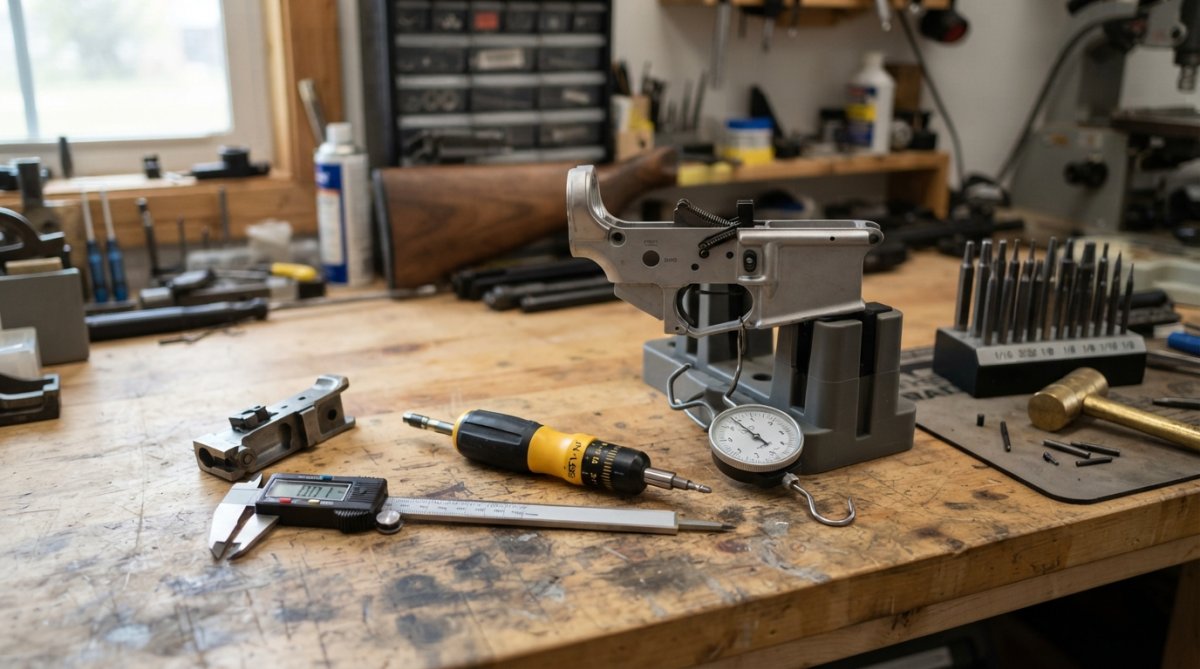
The baseline toolkit includes a quality armorer’s wrench set, a calibrated torque driver, a bench block, and a graduated punch set. A bench block prevents damage to your receiver and frame during disassembly. Pin punches in graduated sizes (typically 1/32″, 3/64″, 1/16″, 5/64″) let you remove springs and pins without marring metal.
Torque Specification and Precision:
Torque specifications are derived from engineering failure testing. Over-tightening a grip screw can crack polymer frames; under-tightening a barrel extension leaves play that degrades accuracy and creates pressure inconsistencies. A calibrated torque driver removes guesswork by clicking when the target is reached.
Manufacturers publish torque specs in inch-pounds (in-lbs) or Newton-meters (N·m). A typical grip screw is 15-25 in-lbs; a barrel nut on an AR platform is 80-100 in-lbs. A click-type torque driver is more reliable than a beam-style wrench because it provides tactile feedback when the target is reached.
Verify your torque driver’s calibration annually. A driver that reads 5-10% off spec introduces cumulative error across multiple fasteners.
Precision Measurement Tools:
Certain modifications require measurement tools to verify safety. Digital calipers (accurate to ±0.01″) let you measure trigger pin diameter, sear engagement depth, and component fit. A headspace gauge is essential for barrel work but requires professional use because improper measurement creates dangerous pressure conditions.
A trigger pull scale ($30-$80) helps verify trigger consistency across multiple presses, though it won’t replace professional measurement.
Thread Locker and Fastener Management:
Vibration from firing loosens screws over time. A drop of medium-strength thread locker (Loctite 243 or equivalent) on grip screws, safety mechanisms, and rail fasteners keeps everything locked and is reversible with heat, unlike high-strength formulas which require significant heat and can damage surrounding components.
Apply thread locker sparingly, a single drop on the threads, not the fastener head. Excess locker can seep into tight tolerances and cure in places you don’t want it.
Invest in a calibrated torque driver early. It costs less than one bad installation and prevents the most common beginner mistakes. Manufacturers publish torque specs for a reason, they’ve tested failure points. Verify your driver’s calibration annually to ensure accuracy within ±5%.
Precision measurement tools like calipers and torque drivers are only useful if they’re accurate. A torque driver that reads 10% high will over-tighten fasteners consistently. A caliper that drifts 0.02″ introduces cumulative error. If you’re unsure about your tool’s accuracy, have it calibrated before starting critical work.
Firearm Customization Safety Best Practices
Mechanical safety means your modification doesn’t create a failure mode, a poorly installed trigger can fail to reset, a misaligned safety might not engage fully, and a barrel swap without headspace verification introduces excessive pressure.
Function test after every modification: rack the slide fifty times for binding, dry-fire test the trigger reset (chamber verified empty), verify safeties engage fully, and check that the slide cycles smoothly.
Legal liability differs: if a modified firearm causes injury, you may face civil or criminal liability. A licensed gunsmith carries liability insurance and follows documented procedures; a DIY builder typically doesn’t.
Improper installation of trigger mechanisms or safety components can create unintended discharge risk or failure-to-fire conditions. Test every modification before live fire, and verify all safety mechanisms engage fully. If you’re unsure, stop and consult a professional.
Many modifications void manufacturer warranties. A trigger job voids the trigger warranty; a barrel swap voids the barrel warranty. This matters significantly if you’re modifying a factory firearm but less if you’re building a clone platform from components.
DIY vs Professional Trigger Job: Weighing Your Options
DIY trigger jobs involve adjusting sear engagement, spring tension, and polishing contact surfaces to achieve a cleaner break. The risk is inconsistent trigger pull weight, a creeping break, or failure to reset.
A professional gunsmith has specialized knowledge, precision measurement tools to verify pull weight consistency, and can diagnose root causes rather than symptoms. They document their work, which matters if you later need to explain modifications in court.
Professional trigger work costs $60+ per hour and may require weeks for an appointment. DIY with drop-in parts takes an afternoon but assumes all risk.
If you’re modifying a platform you plan to shoot regularly, professional trigger work is worth it for consistency. If you’re building a clone platform, DIY with quality drop-in components works fine.
Assessing Your Mechanical Aptitude and Skill Level
Knowing your mechanical aptitude saves money and prevents mistakes.
Have you successfully disassembled and reassembled a complex mechanical device (motorcycle engine, computer, watch)? If yes, you have baseline aptitude for DIY firearm work.
Do you follow instructions precisely or improvise? Firearm work requires precision, you can’t “close enough” a receiver dimension or guess at torque specs. Precision-oriented builders succeed with DIY; improvisers should hire professionals.
Can you admit when something feels wrong and stop? A common beginner mistake is forcing a part that doesn’t fit, assuming it will work itself out. It won’t. Stop and figure out why before proceeding.
Mechanical aptitude is learnable, but precision discipline isn’t always. If you’re naturally careful, methodical, and willing to stop when something feels off, DIY customization is achievable. If you’re comfortable improvising and working around problems, hire a professional.
Start with a drop-in kit designed to work without modification. These teach disassembly, reassembly, and proper function, helping you decide if you’re ready for more complex work.
Legal Implications and Warranty Voidance
Firearm law is state-specific, and some modifications are restricted or illegal depending on where you live. Warranty voidance is often misunderstood, not all customizations void your warranty equally.
Federal and State Legal Restrictions:
Certain modifications are federally regulated under the National Firearms Act (NFA) and the Gun Control Act. Shortening a rifle barrel below 16 inches or a shotgun barrel below 18 inches requires NFA registration and a $200 tax stamp. Suppressors also require NFA registration and a $200 stamp per unit.
Other restrictions vary by state. Some restrict trigger modifications or safety removal; others regulate optic mounts, rail systems, or magazine capacity. Before modifying anything, verify legality in your jurisdiction through your state’s Attorney General office or a local firearms attorney.
A professional gunsmith knows the legal landscape and documents their work. A DIY builder must research legality themselves, where mistakes often happen.
Understanding Warranty Voidance:
Warranty voidance is not binary. Understanding the difference between drop-in parts and modifications that void coverage is critical.
Drop-In Parts (Typically Do Not Void Warranty):
Drop-in parts replace factory components without firearm modification (aftermarket grips, drop-in trigger groups, handguards, sights, magazine wells).
Modifications That Void Warranty:
The Clone Platform Exception:
Liability and Self-Defense Scenarios:
Before modifying any firearm, verify the legality of the modification in your state and local jurisdiction. Some modifications are federally restricted (NFA items). Others are state-specific. Ignorance of the law does not protect you from liability if you modify a firearm illegally. If you use a modified firearm in self-defense, the modification becomes part of the legal record and may affect liability.
Drop-in parts typically do not void warranty because they don’t alter the firearm’s structure. Modifications that alter the firearm (trigger jobs, barrel swaps, receiver work) void the warranty for that component. If you’re building a clone from components, warranty voidance is not a concern because each part carries its own manufacturer warranty. If you’re modifying a factory firearm, understand what warranty you’re giving up and what liability you’re assuming.
When to Hire a Professional Gunsmith
Certain modifications are genuinely better done by a professional. Complex work, precision metalwork, and anything involving headspace or barrel fitting should go to a gunsmith.
Conclusion: Making Your Customization Decision
Firearm customization works both ways. DIY teaches you mechanics and saves money. Professional work guarantees precision and protects you legally. The right choice depends on what you’re modifying and what you’re willing to risk.
Frequently Asked Questions
What tools are essential for basic firearm customization?
Start with a quality bench block to safely support your receiver during work. A pin punch set, armorer’s wrench, and torque driver are non-negotiable for most modifications. Real Avid and similar manufacturers offer beginner kits starting around $20-$40. Drop-in parts like triggers and safety kits require minimal tools, but barrel swaps, optic mounting, and receiver work demand precision measurement tools and torque specifications to manufacturer specs. Invest in quality tools first, cheap punches and blocks cause more problems than they solve.
Does DIY firearm customization void manufacturer warranty?
Yes, most manufacturers void warranty coverage when you modify their firearm. Factory warranty explicitly covers unmodified platforms only. This applies to drop-in parts, trigger replacements, barrel swaps, and any aftermarket accessories. Before starting a project, check your manufacturer’s warranty policy in writing. If your firearm is still under warranty and you need customization, professional installation through an authorized gunsmith may preserve coverage, contact the manufacturer first.
What are the main safety risks of DIY firearm customization?
Improper headspace measurement can cause catastrophic failure. Incorrect torque specifications damage receivers and create binding issues with safeties and triggers. Sear engagement problems lead to unintended discharge or failure to fire. Without precision tools and function testing, you won’t catch these flaws until the firearm is in use. Liability becomes your responsibility entirely, if something goes wrong, you’re liable. Professional gunsmiths have liability insurance and diagnostic equipment to verify reliability before returning your firearm.
Should I hire a professional for my first trigger job or safety kit installation?
If you’ve never disassembled a firearm, start with a professional. A trigger job involves sear engagement and spring kits, mistakes here create safety hazards. Super safety kits can bind if not fitted correctly, and function testing requires understanding mechanical aptitude beyond YouTube videos. Professional labor runs $60-$135 per hour, but one mistake costs far more in repairs, liability, or injury. Once you’ve watched a professional do the work and understand the process, DIY drop-in parts become manageable.
Choose components built for reliability. Polymer Pew offers aluminum MKE lower receivers tested for variant compatibility, flat triggers engineered for consistent pull, and drop-in kits designed for straightforward installation. Whether you’re building your first clone or upgrading an existing platform, start with parts you can trust. Get your Flatties here and build with confidence.