Table of Contents
- Understanding Firearm Internal Component Lifespan
- Signs of Worn Firing Pin and When to Replace It
- Firearm Recoil Spring Replacement Interval and Round Counts
- How to Inspect Firearm Internal Components for Wear
- Metal Fatigue, Polymer Degradation, and Catastrophic Failure
- OEM vs. Aftermarket Parts: Durability and Service Life
- Round Count Tracking and Preventative Maintenance Schedules
- Conclusion
- Frequently Asked Questions
Last Updated: September 18, 2026
Understanding Firearm Internal Component Lifespan
Knowing when to replace firearm internal components separates responsible gun owners from those who risk catastrophic failures. Every internal part, from the firing pin to the recoil spring, has a finite service life determined by round count, material fatigue, and maintenance practices.
The lifespan of these components varies dramatically. A recoil spring might degrade after 3,000-5,000 rounds, while a properly maintained barrel can handle 10,000 rounds or more before accuracy degrades noticeably. The firing pin, extractor, and other critical parts follow different wear patterns depending on ammunition pressure, cycling reliability demands, and how aggressively you shoot.
At Polymer Pew, we emphasize that understanding component service life isn’t optional, it’s foundational to safe, reliable shooting. Whether you’re running a custom build with our precision-engineered parts or maintaining an existing platform, tracking round count and inspecting for wear prevents the surprises that cost money and time.
The challenge most shooters face is knowing what “worn” actually looks like. A component might function perfectly one session and show catastrophic failure the next if metal fatigue has progressed undetected. This guide walks you through the specific wear patterns, inspection techniques, and replacement intervals that keep your firearm running safely.
Signs of Worn Firing Pin and When to Replace It
The firing pin is arguably the hardest-working component in your firearm. It strikes the primer millions of times, and each strike creates microscopic stress fractures in the metal. A worn firing pin won’t fire reliably, and a broken one leaves you with a non-functional gun.
Early signs of firing pin wear include light primer strikes that fail to ignite ammunition. You’ll notice rounds that should have fired sitting in the chamber with shallow indentations on the primer. This happens gradually, the pin loses hardness as metal fatigue accumulates. Another indicator is inconsistent firing: some rounds ignite instantly while others require a second strike.
Visual inspection reveals the real story. A new firing pin has a sharp, clean striking surface. A worn pin shows flattening, rounding, or visible pitting on the tip. If you can see the damage with the naked eye, replacement is overdue. Most shooters should plan on replacing the firing pin every 5,000-10,000 rounds, though this varies by ammunition pressure and firearm design.
The risk of ignoring a worn firing pin extends beyond misfires. A severely degraded pin can break inside the firing pin channel, requiring gunsmith intervention to extract. Replacement is straightforward for most platforms, field strip, remove the old pin, install the new one. The cost of prevention is far lower than the cost of extraction.
Track your round count meticulously. A worn firing pin often shows no external damage until it fails completely. By the time you notice misfires, metal fatigue is already advanced. Preventative replacement at the 8,000-round mark eliminates this risk entirely.
Firearm Recoil Spring Replacement Interval and Round Counts
The recoil spring absorbs the energy of firing and returns the slide or bolt to battery. It’s under constant compression and decompression, which means metal fatigue is inevitable. Unlike the firing pin, a worn recoil spring shows its age through performance degradation rather than visible damage.
A weakening recoil spring manifests as sluggish cycling. The slide returns slower than normal, or you notice the gun doesn’t fully go into battery on the first try. In semi-automatic platforms, this often leads to feeding issues and stoppages. The spring loses tension gradually, so the problem creeps up on you, one day everything feels normal, the next day reliability drops noticeably.
Most recoil springs should be replaced every 3,000-5,000 rounds. High-pressure ammunition accelerates wear, so competitive shooters running hot loads might need replacement every 2,500 rounds. Standard pressure loads allow longer service life. The exact interval depends on your platform, ammunition, and how aggressively you shoot.
Inspection is simple: remove the spring and compare it visually to a new one. A worn spring shows visible compression set, it won’t return to its original length when unloaded. You can also feel the difference: a new spring has crisp resistance, while a worn one feels mushy or inconsistent.
Replacement is one of the easiest preventative maintenance tasks. Most springs cost minimal money and take seconds to swap. The benefit is massive: a fresh recoil spring restores reliability and cycling consistency. For platforms like those upgraded with Polymer Pew’s precision components, using quality replacement springs ensures your investment in other parts performs as designed.
Recoil spring replacement is the single most cost-effective maintenance you can perform. Budget for replacement every 5,000 rounds and you’ll never experience spring-related failures.
How to Inspect Firearm Internal Components for Wear
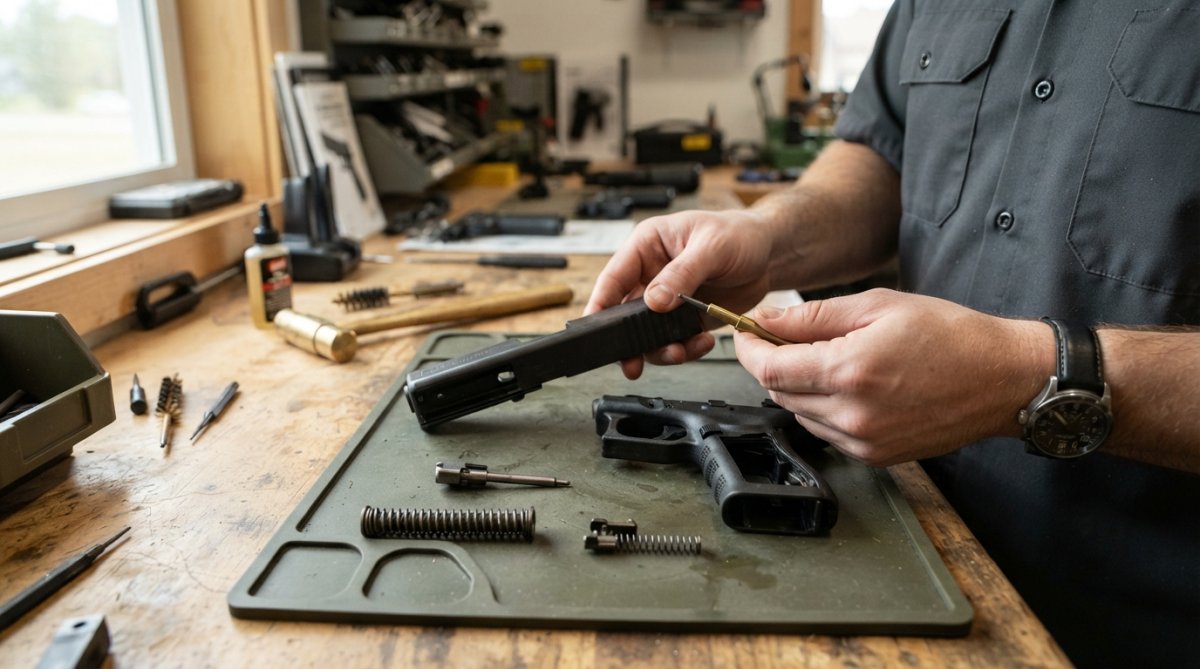
Systematic inspection catches wear before it becomes a problem. Start with a complete field strip, laying each component on a clean surface where you can examine it without rushing. Good lighting is essential, shadows hide the pitting, cracks, and deformation that indicate metal fatigue. Proper magnification and precision lighting serve as the foundation for these essential maintenance tools when evaluating the structural integrity of your firearm.
Check the firing pin first. Look at the tip under magnification if possible. New pins have a sharp, defined striking surface. Wear appears as rounding, flattening, or visible pitting. Run your fingernail across the tip, a new pin feels sharp, a worn one feels dull. Any visible damage means replacement is due.
Inspect the extractor next. This claw must grip the rim of the cartridge case with consistent tension. A worn extractor shows visible wear on the contact surface, or the claw feels loose when you manually work it. Extractors fail gradually, so early detection prevents extraction failures during shooting.
The recoil spring requires visual and tactile inspection. Lay it on a flat surface and compare its compressed length to a new spring. A worn spring won’t return to full extension. Manually compress it several times, resistance should be consistent throughout the stroke. Any softness or inconsistency indicates replacement is needed.
Check the trigger assembly for wear on the sear and trigger surfaces. These components must maintain precise tolerances for reliable, consistent trigger function. Look for visible wear marks or gouging. If the trigger feels gritty or inconsistent, internal wear is likely.
Document your round count and inspection date. Create a simple log noting which components you inspected, what condition they’re in, and when replacement is due. This prevents guessing and ensures you replace components before they fail in the field.
Never assume a component is fine because it looks okay from a distance. Metal fatigue often shows as microscopic cracks that only become visible under magnification. Spend time on thorough inspection, the five minutes you invest prevents costly failures.
Metal Fatigue, Polymer Degradation, and Catastrophic Failure
Metal fatigue is the primary failure mechanism for steel components. Every firing cycle creates stress on the firing pin, extractor, and internal springs. These stresses accumulate, creating microscopic cracks that propagate over thousands of cycles. Eventually, a crack reaches critical size and the component fails suddenly.
Polymer components degrade differently. Many modern firearms use polymer frames or internal parts. Polymer degrades through environmental exposure (UV light, temperature extremes, moisture) and mechanical stress. A polymer component might feel fine for years, then crack or shatter without warning if it’s been stored in poor conditions or subjected to extreme temperatures.
Catastrophic failure happens when a component breaks during firing. A broken firing pin can jam the firing pin channel. A shattered extractor can damage the bolt face.
OEM vs. Aftermarket Parts: Durability and Service Life
OEM (original equipment manufacturer) parts are engineered specifically for your platform. They’ve been tested extensively and carry the manufacturer’s reputation. OEM components typically last longer because they’re designed with exact tolerances and material specifications optimized for that firearm.
Round Count Tracking and Preventative Maintenance Schedules
Round count is the single most reliable predictor of component wear. Unlike calendar-based maintenance, round-count tracking reflects actual stress on your firearm. A gun shot 100 times in a year experiences the same wear as one shot 100 times in a month, calendar time doesn’t matter.
Basic preventative maintenance schedule:
- Every 500 rounds: Clean and inspect for obvious debris or damage
- Every 1,500 rounds: Deep clean, lubricate, and inspect wear patterns
- Every 3,000-5,000 rounds: Replace recoil spring, inspect firing pin and extractor
- Every 5,000-10,000 rounds: Replace firing pin if showing wear, full component inspection
- Every 10,000 rounds: Comprehensive inspection of all internal components, consider professional gunsmith evaluation
Use a simple round-count log. Photograph it after each shooting session. This takes 30 seconds and eliminates disputes about maintenance history. If something fails, you have documented proof of responsible maintenance, which matters for warranty claims and liability.
Conclusion
Knowing when to replace firearm internal components separates responsible ownership from gambling with safety. Track your round count, inspect components regularly, and replace parts before they fail, not after. The firing pin, recoil spring, extractor, and trigger assembly all follow predictable wear patterns when you understand what to look for.
Frequently Asked Questions
What is the average round count before you need to replace firearm internal components?
Round count varies by component and platform. Recoil springs typically last 3,000-5,000 rounds before tension loss becomes noticeable. Firing pins often survive 10,000+ rounds, while extractors may show wear around 5,000-8,000 rounds. High-pressure ammunition and rapid-fire sessions accelerate wear. Track your round count to schedule preventative maintenance before reliability suffers.
How do you know if a firing pin needs replacement?
Signs of worn firing pin include light primer strikes that fail to ignite ammunition, inconsistent ignition across rounds, visible wear or flattening on the pin’s striking end, and difficulty during field strip. Inspect the firing pin tip for erosion or damage. If primers show shallow indentations or light marks, replacement is due soon. Replace before catastrophic failure causes dangerous misfires.
Does improper lubrication accelerate internal component wear?
Yes. Insufficient lubrication increases friction between moving parts, accelerating metal fatigue and wear patterns. Over-lubrication can attract carbon buildup and cause cycling reliability issues. Follow OEM recommendations for your platform. Clean and lubricate your firearm after shooting, especially the recoil spring, trigger assembly, and extractor. Proper maintenance extends service life significantly.
When should you consult a professional gunsmith for internal component replacement?
Consult a gunsmith if you lack experience with field strips, encounter binding issues during reassembly, notice headspace problems, or need to replace multiple components simultaneously. Gunsmiths can verify fitment, check tolerance stacking, and ensure safety before returning your firearm to service. Professional inspection prevents reliability issues and catches hidden damage.