Table of Contents
- Why Tactical Accessories Matter for Home Defense
- Best Budget Weapon Lights for Home Defense
- Non-Lethal Self-Defense Tools That Deliver Real Value
- How to Choose a Home Defense Optic
- Tactical Accessory Installation Best Practices
- Smart Home Integration and Perimeter Security
- Building Your Home Defense Setup on a Real Budget
- Frequently Asked Questions
Last Updated: September 20, 2026
Why Tactical Accessories Matter for Home Defense
Home defense starts with the right tools. The best value tactical accessories for home defense aren’t just for professionals, they’re practical investments that improve your ability to respond quickly and effectively when it matters most. The difference between a prepared homeowner and an unprepared one often comes down to equipment that’s accessible, reliable, and designed for real-world use.
At Polymer Pew, we understand that building a solid home defense setup doesn’t require spending thousands of dollars. It requires smart choices about which accessories deliver genuine value. A tactical flashlight, for instance, serves dual purposes: threat identification and disorientation. A quality non-lethal option gives you a graduated response option. Body armor inserts provide a layer of protection without the bulk of a full carrier. These aren’t luxuries, they’re foundational tools that responsible homeowners consider.
The best value tactical accessories for home defense combine reliability with affordability. You’re looking for equipment that won’t fail when you need it, won’t drain your budget, and actually integrates into your home security strategy rather than sitting unused in a closet. This guide walks through the specific accessories that deliver on those criteria, from weapon-mounted lights to non-lethal self-defense tools, perimeter security, and smart home integration.
Best Budget Weapon Lights for Home Defense
A weapon light is non-negotiable for home defense. The moment a threat emerges, you need to identify what you’re actually facing. Darkness eliminates that advantage. A quality weapon light gives you target identification and a powerful deterrent, most threats retreat when confronted with blinding light.
The Streamlight ProTac Rail Mount HL-X delivers 1,000 lumens with dual-fuel capability, meaning you can run CR123A batteries or standard 18650 rechargeables (ProTac® HL-X | Handheld Flashlight). The remote pressure switch is included, and the build quality is solid enough for serious use. For a home defense rifle or shotgun, this light represents exceptional value.
For handheld use, the SureFire G2X Tactical offers 600 lumens in a compact package. It’s straightforward, single output, durable construction, proven track record. The trade-off is non-rechargeable batteries, but the reliability is worth that minor inconvenience.
| Light | Output | Best For | Key Advantage |
|---|---|---|---|
| Streamlight ProTac HL-X | 1,000 lumens | Mounted on rifle/shotgun | Rechargeable option, dual-fuel |
| SureFire G2X Tactical | 600 lumens | Handheld, bedside | Proven reliability, simple operation |
Mount your weapon light on your primary defensive firearm before you need it. A light you’ve trained with is exponentially more useful than one you’re fumbling to attach during an emergency.
Non-Lethal Self-Defense Tools That Deliver Real Value
Non-lethal options give you graduated response capability. Not every threat requires lethal force, and having alternatives creates legal and ethical flexibility in how you respond.
Pepper gel, like Sabre Tactical Pepper Gel, costs under $20 and provides an 18-foot range with minimal blowback risk. The gel formula sticks to the target, reducing cross-contamination. It’s the cheapest option on this list and belongs in multiple locations: bedside table, entryway, vehicle.
The Byrna SD Pepper Launcher operates at distance, up to 60 feet, using CO2 to fire chemical irritant projectiles. At roughly $300, it’s a significant step up in cost, but the distance advantage is substantial. You can address a threat from across a room without closing distance.
For immediate incapacitation, the Taser Pulse uses electrical probes to disable an attacker. The 15-foot range and built-in laser aiming make it effective, though replacement cartridges are expensive. This sits at the higher end of the non-lethal spectrum.
Non-lethal tools require clear understanding of your local laws. Some jurisdictions restrict pepper spray, tasers, or other devices. Verify what’s legal in your area before purchasing.
How to Choose a Home Defense Optic
An optic fundamentally changes your engagement capability, but home defense optics differ sharply from hunting or competition setups because of distance, lighting, and stress factors. Understanding these constraints helps you avoid overspending on features you won’t use.
Budget Tier ($80-$200): Reflex and Red Dot Sights
Budget red dots like the Bushnell TRS-25 or Sig Sauer Romeo5 deliver 2-3 MOA accuracy at a fraction of premium pricing.
Professional Grade ($300-$800): Aimpoint and Trijicon
Magnified Optics (3x-5x): When They Make Sense
The best value optic for home defense is one you’ve trained with and understand completely. Budget tier delivers 95% of capability at 30% of cost; professional tier adds reliability margin and psychological confidence. Choose based on your training commitment, not marketing claims.
Tactical Accessory Installation Best Practices
Installing tactical accessories correctly matters. A loose light, misaligned optic, or improperly mounted accessory creates problems when you need reliability.
For weapon-mounted accessories, follow these steps:
- Clean the mounting surface completely
- Apply mounting hardware per manufacturer instructions
- Use appropriate torque specifications (usually 15-25 inch-pounds for rail-mounted lights)
- Test functionality before considering the job complete
- Verify zero on any optics after installation
A tactical accessory that’s properly installed and tested is dramatically more reliable than one that’s rushed. Spend the extra 30 minutes to do it right.
Smart Home Integration and Perimeter Security
Modern home defense blends traditional security with smart home technology. A Ring Alarm Security Kit provides motion and contact sensors with mobile app integration. Early detection of perimeter breaches gives you precious seconds to respond.
Building Your Home Defense Setup on a Real Budget
Real budgets require prioritization. You cannot buy everything at once, so understanding which accessories deliver the highest return on investment, and which require training to be effective, prevents wasted spending.
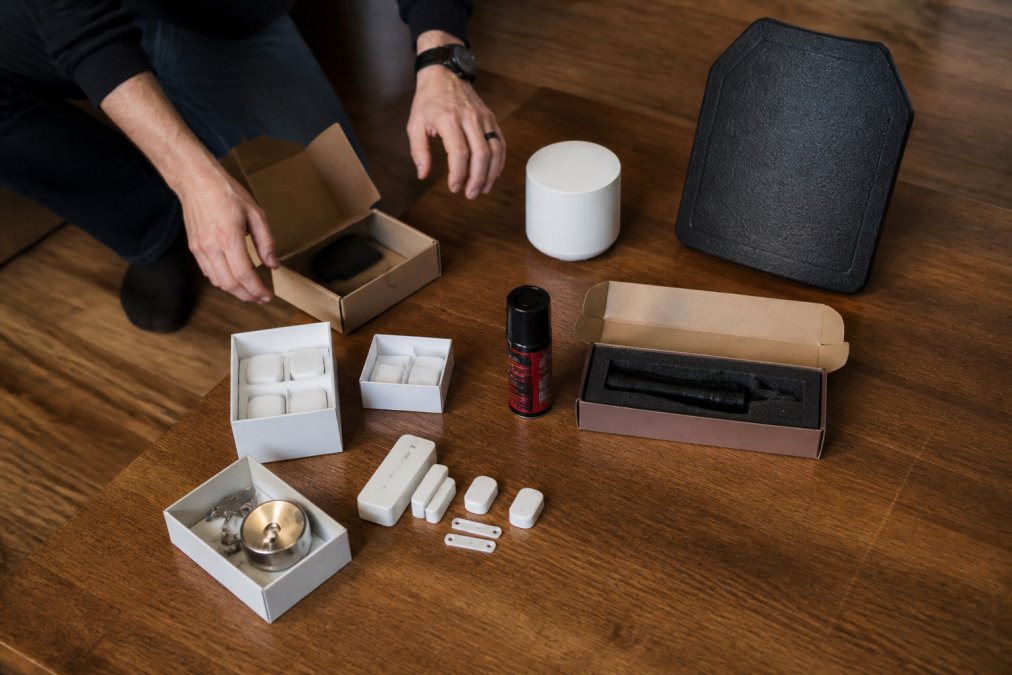
Tier 1: Foundation ($300-$500), Detection and Access Hardening
- Door and window locks: Quality deadbolts ($50-150 per door) and window locks ($10-20 each) are your first line of defense. A Grade 1 deadbolt rated by ANSI (American National Standards Institute) resists forced entry far better than standard hardware. Budget $200-300 for main entry points.
- Motion-activated exterior lighting: $30-80 per fixture. Install at least two fixtures covering entry approaches. This deters opportunistic threats and illuminates your perimeter without manual activation.
- Contact sensors: $10-20 per door/window. Wired or wireless sensors (compatible with Ring, SimpliSafe, or standalone systems) alert you to entry attempts. Budget $100-150 for 8-10 sensors covering all ground-floor entry points.
- Visible security signage: $20-50. Yard signs and window decals indicating alarm system presence deter many threats before they approach.
Tier 2: Immediate Response ($200-$400), Tools You’ll Actually Use
These require basic familiarity but no extensive training.
- Weapon-mounted light: $130-200 for a quality Streamlight or SureFire. This is non-negotiable if you own a firearm for defense. A light you’ve mounted and tested once is infinitely more useful than one you’ve never handled.
- Handheld tactical flashlight: $40-80. Keep one on your nightstand and one near your primary entry point. A 600+ lumen light disorients threats and aids identification.
- Non-lethal option: $20-50 for pepper gel, or $300+ for a Byrna launcher. Pepper gel is the budget choice; it’s effective, legal in most jurisdictions, and requires minimal training. Test it once in a safe environment to understand operation.
- Body armor insert (Level IIIA): $150-200 for a single ceramic or composite plate. Place it in a backpack or carrier near your bed. This is insurance, not daily wear.
Tier 3: Layered Detection ($200-$400), Smart Home Integration
These add early warning but require consistent monitoring.
- Alarm system hub: $100-200 for Ring Alarm, SimpliSafe, or Wyze. These provide mobile alerts and automation triggers.
- Additional motion sensors: $15-30 each. Interior sensors in hallways and common areas detect movement inside your home.
- Smart lock: $150-300. Allows remote access control and activity logging. Useful for family members and emergency responders.
Tier 4: Capability Enhancement ($300-$600), Optics and Advanced Tools
These require training to be effective.
- Red dot sight: $100-300. Only purchase after you’ve trained with iron sights and understand your firearm’s handling.
- Secondary non-lethal launcher: $300-400. A Byrna or similar device extends your response range but requires practice.
- Advanced body armor: $400-800 for multi-hit rated plates. Only justified if you’ve completed defensive training and understand realistic threat scenarios.
Total Tier 4: $300-600+. Impact: Extended capability, requires training.
Realistic Total Budget: $900-$2,000 (Tiers 1-3)
The Training Multiplier
- Home defense firearm course (8-16 hours): $300-600
- Tactical flashlight and low-light navigation: $150-300
- Non-lethal tool familiarization: $50-150
Budget Allocation Strategy
- Months 1-2: Build Tier 1 (detection and hardening). This costs $300-500 and requires no training.
- Months 3-4: Add Tier 2 (immediate response tools). Budget $350-550 and spend one afternoon testing each tool.
- Months 5-6: Pursue defensive training while using Tier 1 and 2 equipment.
- Months 7-12: Add Tier 3 (smart home) and evaluate whether Tier 4 (optics, advanced armor) aligns with your training level and actual threat assessment.
The best value home defense setup prioritizes detection and access hardening first, adds response tools second, and only then pursues advanced capability. Training matters more than equipment cost. A $1,000 setup you’ve practiced with beats a $3,000 setup gathering dust.
Frequently Asked Questions
What are the most essential tactical accessories for home defense on a budget?
Start with three core items: a reliable weapon light (1,000 lumens minimum for threat identification), non-lethal options like pepper gel or a less-lethal launcher for distance-based protection, and perimeter security such as motion sensors or a video doorbell. These address illumination, immediate defense, and early threat detection. Add body armor panels if your budget allows. Polymer Pew’s drop-in kits and components provide reliable performance upgrades without premium pricing.
How do I know if a tactical accessory will actually fit my firearm without modifications?
Check compatibility documentation before purchase. Polymer Pew’s aluminum MKE lower receivers and full metal kits are tested for variant compatibility across common platforms. For weapon lights and optics, verify the mount type (Picatinny rail, direct mount, etc.) matches your firearm’s configuration. When in doubt, contact the manufacturer directly, reputable suppliers like Polymer Pew provide detailed specs and will confirm fit before you buy.
What’s the difference between budget and professional-grade tactical accessories?
Budget accessories prioritize core function and durability at lower cost, using materials like anodized aluminum and stainless steel internals. Professional-grade options add refinements: tighter tolerances, advanced materials, and extended warranties. For home defense, quality budget gear from tested suppliers often exceeds entry-level professional options. The real difference emerges in high-round-count shooting sports or extreme conditions. Polymer Pew’s components bridge this gap, offering hardened construction and compatibility testing at accessible pricing.
Do I need training to use tactical accessories safely?
Yes. Weapon lights require practice to avoid flagging targets unintentionally. Non-lethal tools like pepper gel or conducted energy weapons demand familiarity with effective range and deployment. Body armor requires proper carrier fitting. Most importantly, firearm safety training is non-negotiable. Many ranges and instructors offer short courses on low-light shooting, threat assessment, and accessory operation. Psychological preparedness, knowing when and how to respond, matters as much as the gear itself.