Table of Contents
- Billet vs Forged Receivers: Quick Comparison
- What Is a Forged Receiver?
- What Is a Billet Receiver?
- Are Forged Receivers Mil-Spec?
- 7075 vs 6061 Aluminum Receivers: Alloy Matters
- Pros and Cons of Billet Lower Receivers
- Which Receiver Type Should You Build With?
- Frequently Asked Questions
Last Updated: September 9, 2026
Billet vs Forged Receivers: Quick Comparison
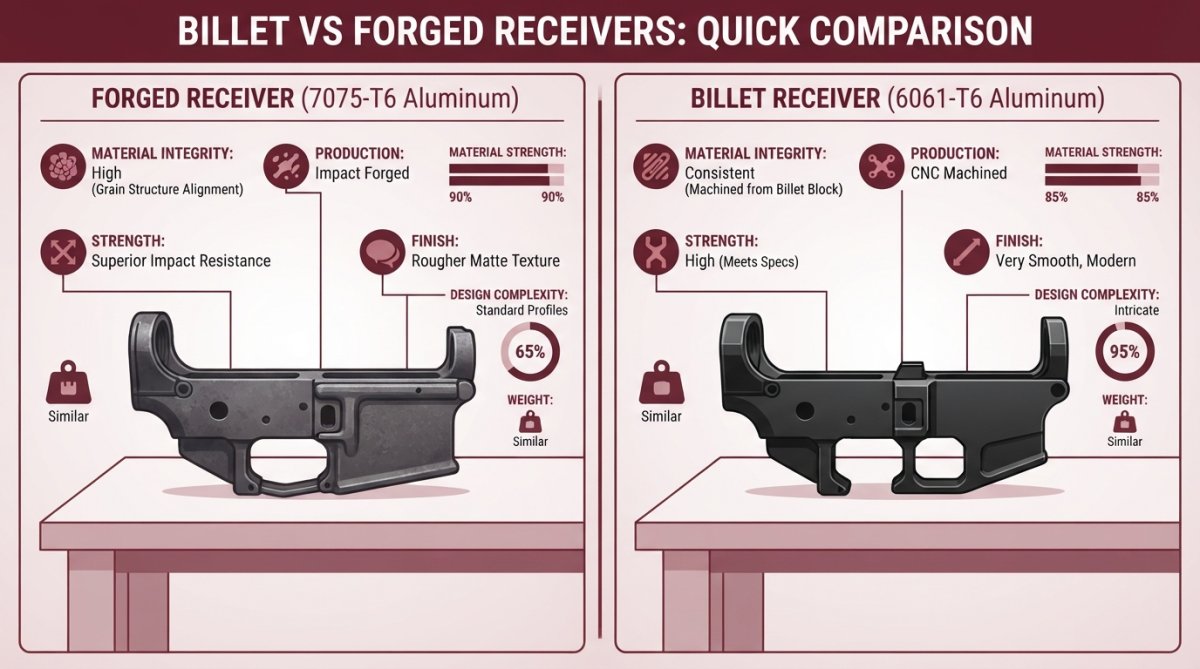
For most AR-15 builds, the practical difference between billet and forged receivers comes down to aesthetics versus cost, not durability. A forged receiver is pounded from a heated aluminum block under pressure; a billet receiver is CNC-milled from a solid block. The real question is what you value more: traditional strength and lower price, or modern styling and tighter fitment.
Forged receivers cost less and carry the proven grain structure of a mil-spec part. Billet receivers offer sharper lines and custom geometry, but you pay more for longer machining time. For a budget clone or workhorse rifle, go forged; for a showpiece with ambidextrous controls, billet wins.
| Feature | Forged Receiver | Billet Receiver |
|---|---|---|
| Manufacturing | Die forging under pressure | CNC machining from solid billet |
| Starting Price | Around $70-$90 | Around $130-$525 |
| Strength | Excellent grain flow | Good, extra material compensates |
| Aesthetics | Standard mil-spec look | Custom, modern styling |
| Weight | Lighter | Generally heavier |
| Best For | Budget builds, mil-spec clones | Custom showpieces, tight fitment |
What Is a Forged Receiver?
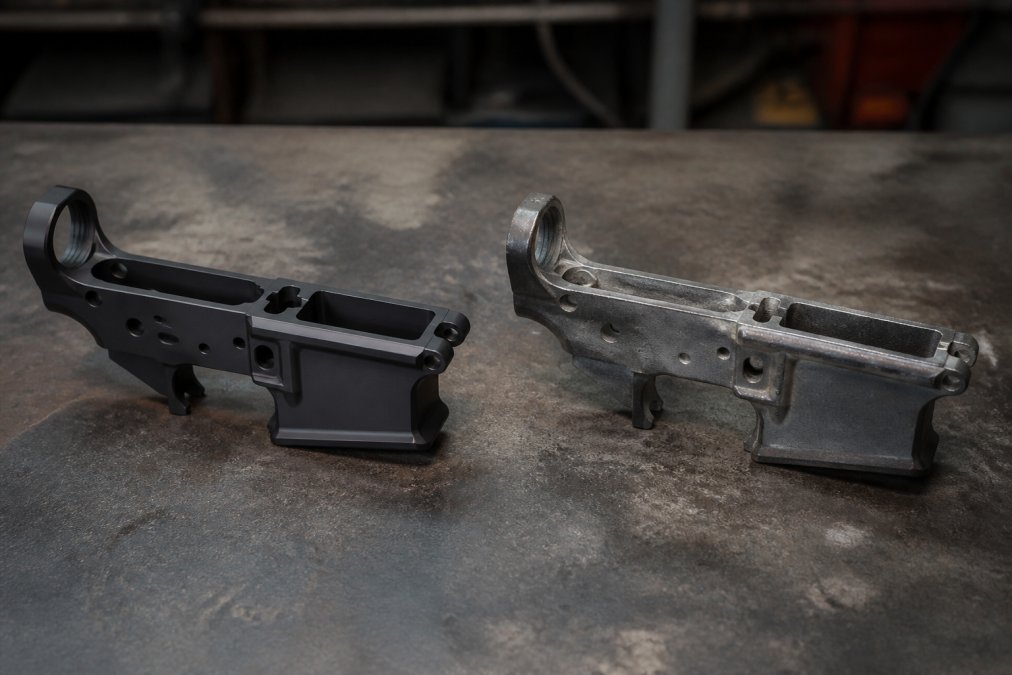
A forged receiver is an aluminum lower or upper created by pressing a heated block of 7075-T6 aluminum between two massive dies. The forging process aligns the metal’s grain structure to follow the shape of the receiver, which is why forged parts have long been the standard for military and law enforcement rifles. The result is a part with excellent structural integrity and impact resistance, all at a production cost low enough to keep prices friendly.
The process starts with a heated blank slammed into shape, then heat treated and hard coat anodized. Because dies cost a fortune, manufacturers stick to mil-spec dimensions, so a forged receiver from one company almost always fits a mil-spec upper from another. This receiver type has armed soldiers for decades and remains the reliability benchmark.
What Is a Billet Receiver?
A billet receiver is machined from a solid block of 7075-T6 aluminum using CNC mills that carve away everything that is not the final part. Instead of relying on dies, a billet receiver is cut directly from a raw blank, which allows for geometric complexity that forging simply cannot produce. Machining time is longer and material waste is higher, which is why billet receivers carry a premium price tag.
Cut from a single block, billet receivers can add features forgings lack, such as integrated tension screws and flared mag wells. The trade-off is no grain flow, so makers add extra material in high-stress areas. A well-designed billet receiver is as durable as a forged one, but weighs more and costs significantly more.
Do not assume billet is stronger just because it looks more substantial. A billet receiver relies on extra material thickness to match the strength of a forging’s natural grain structure. Check the alloy and wall thickness before you buy.
Are Forged Receivers Mil-Spec?
Yes, forged receivers are the definition of mil-spec when they are made to the original military drawings. The term mil-spec refers to the original Colt and ArmaLite specifications for the AR-15 platform, which call for a forged 7075-T6 aluminum receiver with hard coat anodized finish. When you buy a forged receiver from a reputable manufacturer, you are getting the same manufacturing method and material as the rifles issued to troops.
Billet receivers are not mil-spec, since the original platform was never machined from solid billet. That does not make them inferior, but you cannot claim they are mil-spec. For clone correctness or maximum parts compatibility, forged is safer because dimensions are locked to the original spec. With aftermarket parts like the MKE lowers and triggers we stock at Polymer Pew, forged lowers typically drop in with zero modification.
7075 vs 6061 Aluminum Receivers: Alloy Matters
The aluminum alloy is the single biggest factor in receiver durability, and it interacts with the manufacturing method. The two alloys are 7075-T6 and 6061-T6, and the difference is fundamental to how the metal responds to stress.
Grain Flow: The Hidden Difference
Forging aligns the grain structure, the microscopic crystalline boundaries, to follow the part’s contours. This grain flow lets a forged 7075 receiver be thinner in high-stress areas without failing, since grain lines run parallel to stress paths and resist crack propagation.
A billet receiver starts with a random, equiaxed grain structure, and CNC machining cuts through those grains. Stress paths cross grain boundaries at arbitrary angles, so billet designers add extra material around the buffer tower, pivot pin lugs, and trigger pocket to compensate with sheer cross-section.
Tensile Strength vs. Yield Strength
Yield strength matters more than tensile strength for a receiver, it is the point of permanent deformation. For 7075-T6 it is approximately 73,000 psi; for 6061-T6, approximately 40,000 psi, an 82% difference. When a buffer tube bottoms out or a pivot pin lug takes a fall, you are testing yield strength.
Practical Implications for Your Build
- Forged 7075-T6: The mil-spec standard. Best combination of strength, weight, and cost. This is what you want for a rifle that will see hard use, drops, or sustained fire.
- Billet 7075-T6: Equally strong in a well-designed part, but heavier because of the extra material needed to compensate for interrupted grain flow. Acceptable if you value aesthetics and are willing to carry the extra ounces.
- Forged 6061-T6: Rare in quality receivers. The forging process helps, but the alloy is simply too soft for high-stress applications. Avoid for lowers.
- Billet 6061-T6: The budget trap. Easier to machine, so you will see it in cheap receivers. It will work for a range toy, but it is not a duty-grade part.
The Heat Treatment Variable
The “-T6” suffix is not automatic; it refers to solution heat-treated and artificially aged. A receiver stamped “7075” without “-T6” has not been properly aged and will have significantly lower strength. Verify T6 temper on the spec sheet, especially from lesser-known CNC shops.
Do not assume a billet receiver is stronger just because it is thicker. The alloy and heat treatment determine the material’s mechanical properties. A thin-walled forged 7075-T6 receiver will outperform a thick billet 6061-T6 receiver under repeated stress.
How to Verify What You Are Buying
Check the spec sheet for the alloy designation, temper condition, and hard coat anodizing spec (Mil-A-8625 Type III) (everyspec.com). If not published, that is a red flag. Reputable brands, Aero Precision, BCM, Daniel Defense for forged; Radian, LMT, Next Level Armament for billet, list these specs. For smaller shops, ask directly; a 30-second email can save you from a receiver that will not hold up.
The Bottom Line on Alloy
For a lower receiver, 7075-T6 is the only alloy to consider. The manufacturing method determines grain structure and geometry; the alloy determines fundamental strength. A forged 7075 receiver is the proven baseline; a billet 7075 can match it with thoughtful design. Anything in 6061 is a compromise for a low-round-count range rifle only.
Pros and Cons of Billet Lower Receivers
Billet lower receivers shine in aesthetics and customization. The pros and cons are straightforward, and the choice comes down to budget and goals.
Pros:
- Unique, aggressive styling with custom geometry not possible from forging dies
- Tightened dimensional tolerance for reduced upper and lower receiver wobble
- Integrated features like ambidextrous controls and tension screws
- Extra material can be added exactly where stress risers appear
Cons:
- Higher price point due to long machining time and material waste
- Generally heavier because extra material compensates for lack of grain flow
- Less standardized, so compatibility with certain aftermarket parts can vary
- Not mil-spec, which matters for clone builders
Billet lowers are the right pick when you want a custom look and premium fitment, and you are willing to pay for it. Forged lowers are the right pick when you want proven reliability at a lower cost with guaranteed parts compatibility.
Which Receiver Type Should You Build With?
The right answer depends on your build’s purpose. Stop asking “which is better” and ask “which is better for this specific rifle.” Here is a framework for the three most common build categories.
Build Type 1: The Duty or Competition Rifle
Choose forged 7075-T6.
If the rifle will see thousands of rounds, drops, dirt, or a class where failure is not an option, forged is the proven choice. Grain flow gives maximum strength at minimum weight, and mil-spec dimensions guarantee any replacement part drops in without fitting work.
For competition, weight matters: a forged lower typically weighs 8-10 ounces, while a billet with equivalent strength often weighs 11-14 ounces. That difference adds up over a long match, and mil-spec dimensions let you swap parts without proprietary tolerances.
Build Type 2: The Precision or Bench Rifle
Billet is a legitimate choice here, but not for the reason you think.
A bench rifle does not take duty abuse, so strength is irrelevant; fitment matters. Billet receivers are machined to tighter tolerances, meaning less wobble and a more rigid platform for consistent accuracy. For a precision rifle, a reputable billet set can give a more repeatable platform.
Verify the billet receiver’s dimensions are compatible with your trigger and buffer system, as some use different trigger pocket depth or buffer tower geometry. Check the manufacturer’s compatibility list, and confirm drop-in triggers like TriggerTech or Geissele are listed.
Build Type 3: The Budget or Clone Rifle
Forged, without question.
For a military clone or a budget build, forged is the only logical choice. A mil-spec forged lower from Aero Precision or Anderson Manufacturing costs $70-$90; a billet starts at $130 (brownells.com). That $60-$100 difference is better spent on a quality trigger or a bolt carrier group with a properly staked gas key.
For clone builds, billet is not even an option. The original military rifles used forged receivers, and a billet lower will not have the correct external profile or markings. If clone correctness matters to you, forged is the only path.
The Decision Matrix
| Build Priority | Forged | Billet |
|---|---|---|
| Maximum durability | Yes | Only with extra material |
| Minimum weight | Yes | No |
| Tightest fitment | Mil-spec standard | Tighter tolerances possible |
| Custom aesthetics | No | Yes |
| Parts compatibility | Universal | Verify each part |
| Budget | $70-$90 | $130-$525 |
| Clone correctness | Yes | No |
The Verdict
For a rifle that will be carried, dropped, and shot hard, buy forged. For precision with tightest fitment, billet can be justified after verifying compatibility. For budget or clone correctness, forged is the only answer. The receiver is the foundation, but it is not what makes the rifle accurate or reliable, spend on the barrel, bolt carrier group, and trigger first, then choose the receiver that fits your budget and purpose.
Match the receiver to the mission. Duty and budget builds: forged 7075-T6. Precision builds where fitment is critical: billet 7075-T6 with verified compatibility. Never compromise on alloy, 7075-T6 is non-negotiable for a lower receiver.
Frequently Asked Questions
Is a billet stronger than forged?
Forged receivers generally have a slight edge in raw strength because the forging process aligns the aluminum’s grain structure along the receiver’s contours. Billet receivers start as a solid block, so they lack that grain flow. In practice, both 7075-T6 forged and billet receivers exceed the strength demands of a standard AR-15 build. The difference matters more in theory than in real-world use for most shooters.
Are billet lowers worth the extra cost?
Billet lowers cost more because CNC machining from a solid block takes longer and wastes more material than forging. You pay for tighter tolerances, reduced receiver wobble, and design features like integrated trigger guards or tension screws that forged receivers cannot offer. If those features matter to you, the premium is worth it. If you just want a reliable rifle, a forged lower performs identically for less money.
What is the best material for AR-15 lower receivers?
7075-T6 aluminum is the standard for quality AR-15 receivers, whether forged or billet. It offers a better strength-to-weight ratio than 6061-T6, which is why mil-spec receivers use it. 6061 is easier to machine, so some budget billet parts use it, but 7075 resists bending and impact better. Stick with 7075-T6 for any receiver that needs to hold up over thousands of rounds.
Do billet receivers offer better compatibility than forged?
Forged receivers are built to mil-spec dimensions, which means they accept virtually every aftermarket part without fitment issues. Billet receivers often use tighter tolerances, which improves the upper-to-lower fit, but those tighter specs can occasionally cause binding with certain trigger groups or pivot pins. Check the manufacturer’s compatibility notes before pairing a billet lower with aftermarket parts.
The receiver is the foundation of your build, but the trigger is where performance lives. At Polymer Pew, we pair quality lowers with tested drop-in triggers, super safety kits, and flat triggers built from anodized aluminum housings and stainless steel internals, all designed for reliable compatibility with your platform. Get your Flatties here and finish your build with components you can trust.