Table of Contents
- Why Fundamentals Beat Hardware Every Time
- Best Drop-In Pistol Triggers That Tighten Your Groups
- Affordable Red Dot Sights for Pistols: Do They Help?
- Grip, Stippling, and Ergonomics Mods That Fit Your Hands
- Dry Fire Practice Drills for Accuracy You Can Run at Home
- Maintenance and Ammo: The Accuracy Mods Nobody Mentions
- The Law of Diminishing Returns: When to Stop Spending
- Frequently Asked Questions
Last Updated: September 11, 2026
Why Fundamentals Beat Hardware Every Time
Improving pistol accuracy with affordable mods starts with an uncomfortable truth: most shooters buy gear when they should be buying reps. Most shooters buy gear when they should be buying reps. We’ve watched hundreds of builds with match-grade triggers, upgraded sights, and stippled frames shoot the same 6-inch groups at 15 yards because the shooter never fixed their grip or trigger press.
Pistol accuracy is the measurable ability to place rounds consistently on target, and it comes from two sources: mechanical accuracy (what the gun is capable of) and shooter accuracy (what you can extract from it). Most factory pistols shoot better than their owners, a stock Glock 19 holds tighter groups than 90% of shooters can produce offhand (nra.org).
The NRA’s fundamentals of marksmanship guide lays out the five pillars every shooter needs before hardware matters: sight alignment, trigger control, grip, stance, and follow-through. Mods amplify good fundamentals. They expose bad ones.
Buying a red dot before you can shoot tight groups with irons is the most common mistake we see. The dot doesn’t fix flinching, it magnifies it. You’ll chase the dot across the target and blame the optic.
Best Drop-In Pistol Triggers That Tighten Your Groups
A drop-in trigger is the single most effective hardware mod for most shooters. The best drop-in pistol triggers reduce pull weight, shorten reset, and eliminate the creep that pulls shots left or low.
What a Trigger Swap Actually Fixes
A trigger swap fixes the interface between your finger and the sear. Factory striker-fired triggers run 5.5 to 7 pounds with noticeable take-up and a gritty break; a quality drop-in lands between 3.5 and 4.5 pounds with a cleaner wall and a reset you can feel (glock.com).
That cleaner break matters more than the weight reduction. Most shooters who “pull shots” aren’t jerking the trigger, they’re fighting a vague break point and adding input at ignition.
Drop-In vs. Gunsmith Fit: What to Expect
Drop-in triggers install with basic tools and no fitting. Gunsmith-fit units require stoning the sear engagement and sometimes modifying the trigger bar. Drop-in is right for 95% of shooters.
| Option | Install Time | Tools Needed | Best For |
|---|---|---|---|
| Drop-in trigger kit | 15-30 min | Punch set, small screwdriver | Most shooters, first upgrade |
| Gunsmith-fit trigger | 1-2 hrs + fitting | Stones, jig, calipers | Competition builds |
| Polished factory trigger | 45 min | Stones, patience | Budget builds |
Our flat triggers and super safety kits are built for the drop-in crowd. Anodized aluminum housings with stainless steel internals give a consistent break without the fitting headaches of match-grade parts.
Before you install any trigger, dry-fire the stock unit 50 times and note exactly where the break happens. After the swap, do the same. If you can’t feel the difference, the trigger isn’t your bottleneck.
Affordable Red Dot Sights for Pistols: Do They Help?
Affordable red dot sights for pistols absolutely help, but not for the reason most people think. They don’t make you more accurate. They make your errors visible.
A red dot shows every flinch, grip shift, and moment of anticipation in real time. Shooters who train with a dot for 30 days typically see faster target acquisition and tighter groupings than those on irons alone. The dot doesn’t do the work, it removes the guesswork.
Red Dot vs. Iron Sights: Which Improves Pistol Accuracy Faster?
Red dots improve pistol accuracy faster for new shooters, while irons build better long-term fundamentals. The dot gives you a single focal plane, eliminating the sight alignment problem, you just put the dot on the target and press.
Factory sights are the weak point on most pistols. Fiber optic or tritium sights are a cheap win for varied lighting, fiber optic pops in daylight, tritium glows in low light.
The catch: a dot adds bulk, requires a mounting plate on most pistols, and demands you re-learn your draw. Budget two weeks of dry fire before you trust it in a match.
Mounting Footprints, Dot Size, and the Trade-Offs Nobody Lists
The biggest compatibility trap with budget pistol dots is the mounting footprint. Most sub-$250 optics use one of four patterns: RMSc (Shield), Holosun K (407K/507K), Docter/Noblex, and the full-size Trijicon RMR. A pistol cut for RMSc won’t accept an RMR without an adapter plate, and plates add height, changing your sight picture and potentially pushing the dot above your irons.
Before you buy, confirm three things:
- Slide cut or plate? A factory optics-ready slide (Glock MOS, Sig Sauer X-Series, Smith & Wesson M&P C.O.R.E., Springfield Hellcat OSP) ships with a plate system. A direct-milled slide is more rigid but locks you into one footprint.
- Dot size. A 2 MOA dot is precise at distance but slower to pick up on the draw. A 6 MOA dot is faster up close but covers more of a small target at 25 yards. Most defensive shooters land on 3 to 4 MOA.
- Co-witness height. Lower 1/3 co-witness keeps your iron sights visible in the bottom of the window; absolute co-witness puts the dot right on top of the front post. Lower 1/3 is the more common preference.
Battery, Brightness, and the Budget Traps
Two features separate a dot that survives a year of carry from one that dies in a drawer:
- Shake-awake and auto-brightness. Sleeping when holstered and waking on movement stretches battery life from weeks to months, while auto-brightness keeps the dot from washing out in sun or blooming in a dark room.
- Side-load battery tray. A tray you can open without removing the optic lets you swap a battery without re-zeroing; bottom-load trays force you to unmount the dot and re-zero every time.
Battery life on quality budget dots is measured in tens of thousands of hours at mid brightness, but that collapses at max brightness. Treat the advertised figure as a best case, not a guarantee.
Zero your dot at 10 yards, not 25. Most defensive pistol engagements happen inside 15 yards, and a 10-yard zero keeps the dot within a couple of inches of point of aim out to 25. Confirm your hold at 25 before you trust it.
A red dot does not fix a flinch. If your groups open up when you switch to a dot, the dot is doing its job, it’s showing you a problem the irons were hiding. Go back to dry fire before you blame the optic.
What a Dot Actually Costs You
A budget dot, mounting plate, and taller co-witness irons typically cost more than a drop-in trigger and fiber optic sights combined. The dot is the biggest single accuracy upgrade for a new shooter, but it demands the most re-training. If you won’t put in two weeks of daily dry fire to re-learn your draw and index, spend the money on ammo instead.
Grip, Stippling, and Ergonomics Mods That Fit Your Hands
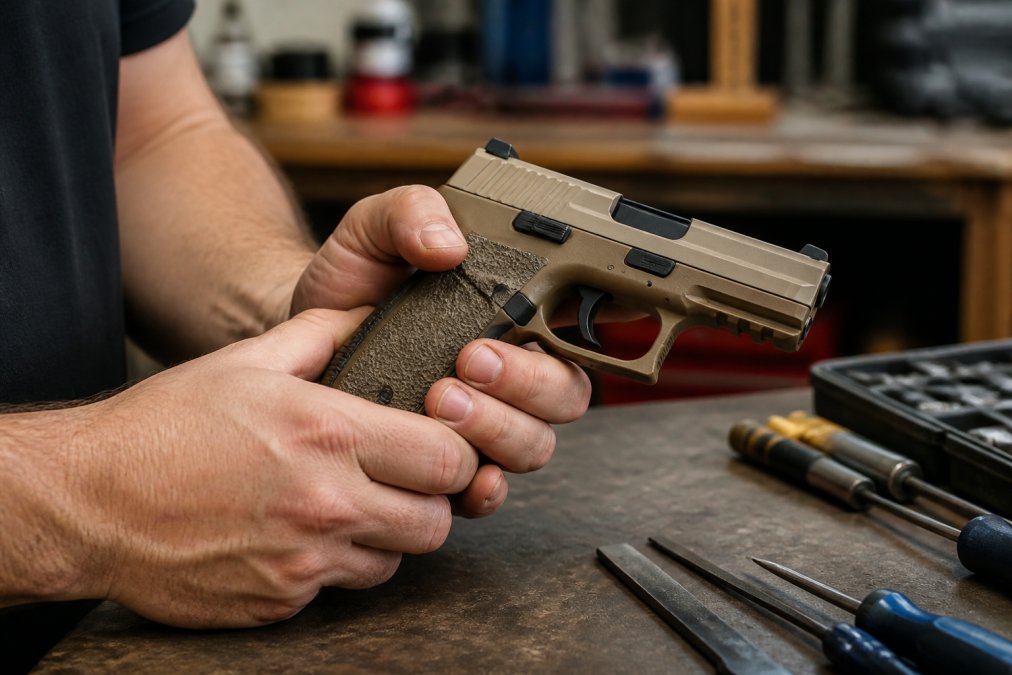
Grip mods are the most underrated accuracy upgrade in the game. If your hands don’t fit the gun, no trigger or optic will save your grouping.
Start with grip texture. Factory polymer frames are slick, especially with sweaty hands. Stippling adds traction but is permanent and easy to overdo, try a rubber or granulate grip wrap before taking a soldering iron to your frame.
Backstrap size matters more than most shooters admit. If you have small hands, a thinner backstrap lets you reach the trigger with the pad of your finger instead of the joint. That single change fixes more fliers than any trigger swap.
Magazine release and slide release extensions help shooters with shorter thumbs. They’re cheap, reversible, and make manipulation faster under stress.
Fit beats finesse. A pistol that points naturally for your hand size will outshoot a tricked-out gun that fights your grip every time you present it.
Dry Fire Practice Drills for Accuracy You Can Run at Home
Dry fire practice drills for accuracy are the highest-return investment in this article: no ammo cost, no range fee, no commute. Twenty minutes a day for two weeks will change your shooting more than any part you can bolt on.
Three Drills That Fix Sight Alignment and Trigger Reset
- Wall drill. Point at a blank wall, align your sights, and press the trigger without letting the front sight move. Ten reps per session. This builds the trigger control that mods can’t buy.
- Reset drill. Press, hold, and slowly release until you feel the trigger reset. Repeat without re-breaking. This teaches trigger reset as a tactile event, not a guess.
- Balance drill. Place a coin or empty casing on your front sight and press the trigger without dropping it. If the coin falls, you’re adding input.
Pair these with a shot timer app and track your first-shot time. Consistency in dry fire translates directly to consistency on paper.
Maintenance and Ammo: The Accuracy Mods Nobody Mentions
Every other article on this list will sell you a part. This section covers the accuracy mods that cost nothing: cleaning, lubrication, and ammunition selection. A fouled barrel, dry slide, and gunked-up extractor all degrade shot grouping, and none show up on a parts list.
How Fouling Actually Opens Your Groups
A pistol barrel accumulates carbon, copper jacket fouling, and lead (with cast bullets). Carbon builds first and is least harmful. Copper fouling is what matters for accuracy, as it layers unevenly in the rifling, it changes how the bullet engages the lands and grooves, gradually widening your groups rather than shifting them suddenly.
Most shooters won’t notice copper fouling until groups open by an inch or more at 15 yards. By then, one pass with copper solvent and a bronze brush typically restores previous accuracy, so clean before the fouling stacks, not after.
A practical schedule that works for most shooters:
- Every 500 to 1,000 rounds: Field-strip, clean the barrel with solvent and a bore brush, wipe the feed ramp, and re-lube the slide rails and barrel hood.
- Every 2,000 to 3,000 rounds: Detail-strip the slide, clean the extractor and its channel, and inspect the striker channel for debris.
- After any range session in rain, dust, or sand: Wipe down and re-lube, regardless of round count.
Lubrication: Where a Drop Helps and Where It Hurts
Lube is the cheapest accuracy mod you can make and the easiest to get wrong. The rule: oil the sliding surfaces, keep oil out of the ignition path.
- Lube these: slide rails, barrel hood, barrel bushing or lockup area, and the outside of the barrel where it contacts the slide.
- Keep dry: striker channel, firing pin, extractor channel, and the inside of the magazine well.
A drop of oil in the striker channel is the classic cause of light strikes and inconsistent ignition. The symptom looks like an inaccurate gun, rounds landing low or off-call, but the cause is a striker hitting the primer with inconsistent force. If groups open up after a cleaning, check the striker channel first.
Over-lubrication causes its own problem: excess oil attracts carbon and grit, forming a lapping compound that accelerates slide rail wear. A thin film is the goal, not a puddle.
Ammo: The Variable You Can Actually Control
Ammo matters as much as cleaning. Match-grade ammo tightens groups in almost every pistol because match loads hold tighter tolerances on bullet weight, seating depth, and powder charge, which translates to a smaller extreme spread on target. You don’t need to shoot it every session.
Zero your defensive or competition load, then practice with cheap range ammo that has a similar point of impact. If your practice ammo shoots 4 inches off from your carry ammo at 15 yards, you’re training the wrong hold.
A few things to check when you’re picking practice ammo:
- Bullet weight. A 115-grain and a 147-grain load will print at different points of impact in the same pistol. Pick one weight and stick with it.
- Velocity. Higher-velocity loads tend to shoot lower because the bullet exits the barrel earlier in the recoil cycle. If your carry ammo is a +P load, practice with something close to that velocity.
- Group size, not just point of impact. Some budget ammo shoots to point of aim but patterns. If your groups double in size with a particular brand, that brand is the problem, not your trigger press.
Before you buy your next part, run 200 rounds of your carry ammo through a clean, properly lubed pistol and measure the group. That number is your baseline. Every mod after this should be judged against it, and if a $0 cleaning restores the group you had 1,000 rounds ago, you just saved yourself the cost of a barrel.
The Maintenance Log Habit
Keep a simple log: date, round count, cleaning performed, ammo used, and group size at a known distance. After a few months, patterns emerge, you’ll see how many rounds it takes before groups open, and whether the fix is cleaning, lube, or a new part. That log is the cheapest diagnostic tool in this article.
The Law of Diminishing Returns: When to Stop Spending
Every dollar spent on pistol accuracy mods delivers less improvement than the last. That’s the law of diminishing returns, and it hits hard around the $300 mark.
Here’s the honest sequence:
- $0: Dry fire, grip, and sight alignment practice
- $50-100: Fiber optic or tritium sights, grip wrap
- $100-200: Drop-in trigger
- $200-400: Budget red dot and mounting plate
- $400+: Barrel, compensator, custom frame work
Past that last tier, you’re buying fractions of an inch that only matter in a match you’re probably not winning yet. Most shooters should stop at the trigger and optic and put the rest into ammo and range time.
The DIY vs. gunsmithing question lands here too. If a mod requires fitting, stoning, or permanent frame modification, pay a gunsmith, a botched DIY job on a frame costs you a new frame. Drop-in parts are designed for the home builder, and that’s exactly what our aluminum MKE lowers and full metal kits are built for.
Frequently Asked Questions
Do aftermarket triggers actually improve pistol accuracy?
They can, but not the way most people expect. A cleaner trigger with a consistent pull weight makes it easier to press straight through without disturbing sight alignment, which tightens shot grouping. It doesn’t fix flinching or poor follow-through. Pair a drop-in trigger with dry fire practice and you’ll see the real gains. A trigger alone, without training, usually just feels nicer at the range.
What is the most effective budget-friendly pistol upgrade?
For most shooters, a set of fiber optic or tritium sights and a trigger upgrade deliver the biggest return for the money. Fiber optic front sights make target acquisition faster in daylight, and a drop-in trigger smooths out the pull so your point of impact stays consistent. Grip texture and a backstrap change are cheap too, and they help if the factory grip doesn’t match your hand size.
How much do sights affect pistol accuracy?
Sights don’t change mechanical accuracy, but they change how precisely you can align the pistol. Factory sights with a wide rear notch and a fat front post make sight picture harder to repeat. Fiber optic or tritium replacements sharpen the front sight focus, which tightens shot grouping. For many shooters, sights are the first mod because the improvement shows up the same day at the range.
Are drop-in pistol parts reliable for self-defense?
Quality drop-in parts are reliable when they’re made from hardened materials and tested for fit. The risk comes from cheap, unverified kits that bind or shift under recoil. Stick with components that use anodized aluminum housings and stainless steel internals, and run at least a few hundred rounds through the pistol before trusting it for concealed carry. Function check and live fire confirmation matter more than the label on the box.
Most shooters plateau because they keep buying parts instead of fixing fundamentals. The mods in this guide work, but only when they sit on top of solid trigger control, consistent grip, and regular dry fire. Polymer Pew builds drop-in triggers, super safety kits, and full metal kits with anodized aluminum housings and stainless steel internals for shooters who want real performance without gunsmith prices. Get your Flatties here and start tightening your groups this week.