Table of Contents
- Why Budget AR-15 Triggers Matter for Your Build
- Single Stage vs Two Stage Trigger for AR-15: Which Type Fits Your Budget
- Top Budget AR-15 Trigger Alternatives to TriggerTech
- How to Install an AR-15 Trigger: Drop-In vs Assembly
- Performance Metrics: Pull Weight, Reset, and Consistency
- Durability and Long-Term Reliability on a Budget
- Conclusion
Last Updated: August 9, 2026
Why Budget AR-15 Triggers Matter for Your Build
A quality trigger transforms how your AR-15 shoots. The difference between a gritty mil-spec pull and a crisp, predictable break means tighter groups, faster follow-ups, and a rifle that feels like an extension of your shooting. Premium triggers like TriggerTech command $200+, making them unrealistic for budget builders.
Budget AR-15 triggers solve this problem. This guide analyzes top budget alternatives, breaks down single-stage versus two-stage designs, and provides installation guidance and performance metrics.
Budget triggers often outperform mil-spec by a significant margin at a fraction of the cost. The key is matching the trigger type to your intended use, precision shooting demands different characteristics than duty or plinking.
Single Stage vs Two Stage Trigger for AR-15: Which Type Fits Your Budget
The choice between single-stage and two-stage triggers is fundamental. Each design has distinct advantages, and your budget doesn’t limit you to inferior performance, it determines which type makes sense for your needs.
Single-Stage Triggers: Simplicity and Crisp Break
A single-stage trigger releases the hammer directly when you apply pressure, with no distinct take-up phase. You get a direct, predictable break with minimal creep. Single-stage triggers excel in duty and tactical applications where you need fast target transitions and reliability under stress. The crisp break means less guesswork about when the shot will break, translating to tighter groups during rapid fire. Pull weights typically range from 3.5 to 4.5 pounds on budget options, heavy enough for safety but responsive enough to feel good.
The trade-off is reduced control for precision shooting. If you’re building for competition or long-range work, a two-stage design usually feels more natural. Rise Armament’s Rave 140 and Timney’s Impact represent the sweet spot for budget single-stage triggers, delivering crisp breaks, drop-in installation, and reliability at a fraction of premium prices.
Two-Stage Triggers: Control and Precision
A two-stage trigger has a distinct first stage of take-up before the sear engagement point. This design favors precision shooters because it allows deliberate staging rather than surprising yourself with a break. The LaRue MBT-2S consistently shows why this trigger dominates the budget two-stage market. The smooth first stage and crisp second stage provide control without requiring assembly expertise.
Two-stage triggers excel in precision rifle, hunting, and competition shooting where you have time to stage the trigger and break the shot at the exact moment you want. Pull weights typically total 4.5 to 5 pounds. The downside is that they require more trigger control discipline and are more complex, though quality budget options like the LaRue eliminate failure concerns through solid engineering.
Single-stage triggers prioritize speed and simplicity; two-stage triggers prioritize control and precision. Your choice should match your intended use, not your budget. Quality options exist for both designs.
Top Budget AR-15 Trigger Alternatives to TriggerTech
The market has matured significantly. You’re no longer choosing between premium performance and budget mediocrity. Instead, you’re selecting which feature set and installation method best suits your build.
| Trigger | Type | Pull Weight | Installation | Best For |
|---|---|---|---|---|
| Polymer Pew Flat Trigger | Single-Stage | 3.5-4.5 lb | Drop-In | Budget builds prioritizing reliability |
| Rise Armament Rave 140 | Single-Stage | 3.5 lb | Drop-In | Value-conscious shooters wanting crisp break |
| LaRue MBT-2S | Two-Stage | 4.5 lb | Assembly Required | Precision shooting on tight budget |
| Timney Impact | Single-Stage | 3-4 lb | Drop-In | Shooters valuing Timney’s reputation |
| PSA EPT | Single-Stage | 5+ lb | Assembly Required | Entry-level builders under $50 |
| HIPERFIRE EDT Heavy Gunner | Single-Stage | Heavy | Assembly Required | Steel-cased ammo reliability |
Polymer Pew Flat Trigger: The Budget Build Foundation
Polymer Pew’s flat trigger kit delivers reliable performance without compromises on essentials. Built with hardened stainless steel internals and anodized aluminum housing, this trigger provides durability for platforms lasting thousands of rounds. What sets this option apart is compatibility testing across multiple lower receiver platforms, eliminating fitment guesswork for builders. The crisp break is consistent, and the audible reset confirms trigger function between shots.
Rise Armament Rave 140: The Value Champion
The Rise Armament Rave 140 has become the reference point for what a sub-$150 single-stage trigger should deliver. The 3.5-pound pull weight is light enough to feel responsive but heavy enough for safety. The break is crisp with no creep, and the reset is short and audible.
What makes the Rave 140 exceptional value is the drop-in design. You remove the mil-spec trigger group and install a complete assembly, no gunsmithing experience required. Rise offers both curved and flat trigger bows, and included anti-walk pins prevent trigger pins from gradually migrating out of the lower receiver. The Rave 140 excels in duty and general shooting applications.
LaRue MBT-2S Review: Best Two-Stage Value
The LaRue Tactical MBT-2S represents the best argument for two-stage triggers on a budget. The engineering is transparent: S7 tool steel construction, a smooth first stage, and a crisp second stage that breaks predictably. The total pull weight lands around 4.5 pounds.
This trigger requires assembly, you’re installing it into your lower receiver, not dropping it in as a complete unit. For most builders, this isn’t a barrier. The installation is straightforward, and the reward is a trigger that feels significantly more refined than its price suggests. The two-stage design makes the MBT-2S ideal for precision shooting, hunting, and competition applications.
The MBT-2S requires assembly. If you’ve never installed a trigger group, watch a tutorial first. The pin orientation matters, and getting it wrong means your trigger won’t function. Take 15 minutes to understand the process before starting.
Timney Impact: Proven Reliability on a Budget
Timney has built a reputation on quality triggers, and the Impact brings that reputation to the budget segment. The trigger uses EDM wire-cut S7 tool steel for the hammer, housed in lightweight aluminum alloy. The factory pre-set pull weight ranges from 3 to 4 pounds.
What you’re paying for with Timney is proven reliability. The crisp, clean break is consistent, and the short reset enables quick follow-up shots. The Impact is drop-in, making installation straightforward. For shooters valuing simplicity, reliability, and confidence in an established manufacturer’s name, the Impact delivers.
PSA Enhanced Polished Trigger: The Entry-Level Option
Palmetto State Armory’s Enhanced Polished Trigger (EPT) occupies a unique position: it’s the cheapest option on this list and still a meaningful upgrade over mil-spec. The polished contact surfaces reduce grit and creep compared to standard mil-spec triggers.
This trigger is mil-spec compatible, using the same pins and housing as your lower receiver. Installation is straightforward, remove the old trigger group and install the new one. The trade-off is that the EPT is fundamentally a mil-spec trigger with a relatively heavy pull weight, typically 5+ pounds. But if you’re building your first AR-15 and want a noticeable improvement over the factory trigger without significant expense, the EPT delivers real value.
HIPERFIRE EDT Heavy Gunner: Duty-Rated Performance
The HIPERFIRE EDT Heavy Gunner prioritizes reliability over light pull weights. The heavy hammer is designed to reliably ignite primers that are harder than standard, which matters if you’re shooting steel-cased ammunition or military surplus rounds. This trigger requires assembly and makes sense for shooters prioritizing reliability above all else, especially those shooting hard-to-ignite ammunition.
How to Install an AR-15 Trigger: Drop-In vs Assembly
Installation difficulty shouldn’t drive your trigger choice. Both drop-in and assembly-required triggers are within reach of most builders with basic tools and 30 minutes of time.
Drop-In Installation: No Gunsmithing Required
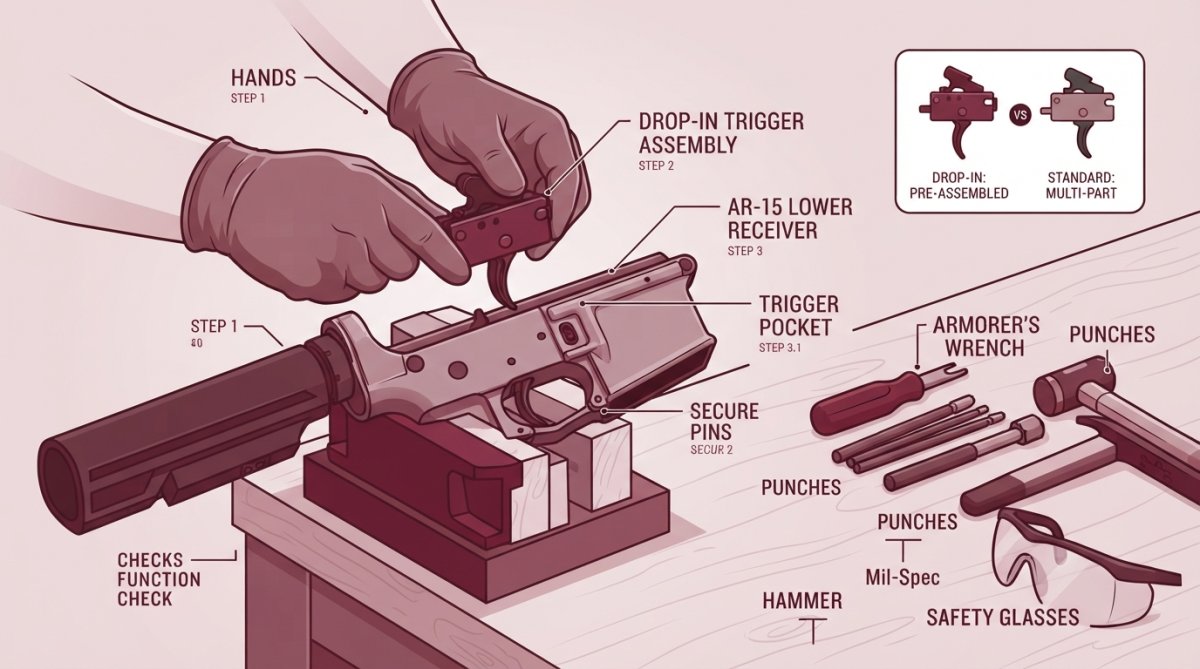
A drop-in trigger is a complete assembly that installs as a single unit. You remove your existing trigger group and install the new one. This method takes 10-15 minutes and requires only a punch tool to remove the old trigger pins.
Secure your lower receiver in a vice, punch out the trigger pins from the rear, remove the old trigger group, insert the new drop-in assembly, and install the new pins. Some drop-in triggers come with anti-walk pins that prevent gradual pin migration, install these instead of standard pins if included. Drop-in triggers like the Rise Armament Rave 140 and Timney Impact excel because they eliminate assembly complexity and reduce installation error risk.
Assembly-Required Triggers: What to Expect
Assembly-required triggers like the LaRue MBT-2S ship as component kits. You’re installing the trigger, hammer, springs, and disconnector into your lower receiver. This requires understanding component interaction and correct pin orientation.
The process takes 20-30 minutes if you’ve done it before, longer if this is your first time. You’ll need a punch tool, a small hammer, and ideally a trigger pin holder or jig. Read installation instructions completely and watch a video tutorial specific to your trigger model. The advantage of assembly-required triggers is cost, manufacturers save money by shipping components rather than pre-assembled units, and that savings transfers to you.
Common Installation Mistakes to Avoid
The most frequent mistake is installing trigger pins backwards. On many triggers, the front pin has a specific orientation, check your instructions. Another common error is over-tightening or under-tightening the trigger pin. The pin should be snug enough that the trigger doesn’t rattle, but not so tight that the trigger is stiff or binding. Hand-tight is usually correct.
Spring tension is another area where builders get stuck. If your trigger feels mushy or won’t reset, the hammer spring is likely not properly seated. Remove the assembly, verify the spring is correctly positioned, and reinstall.
If your trigger doesn’t reset after installation, stop immediately. Do not dry-fire with the trigger not resetting. Continuing to dry-fire a non-resetting trigger can damage the hammer or sear. Remove the trigger group and verify component orientation before troubleshooting further.
Performance Metrics: Pull Weight, Reset, and Consistency
Understanding trigger performance metrics helps you evaluate whether a specific trigger matches your needs. These directly affect how your rifle shoots.
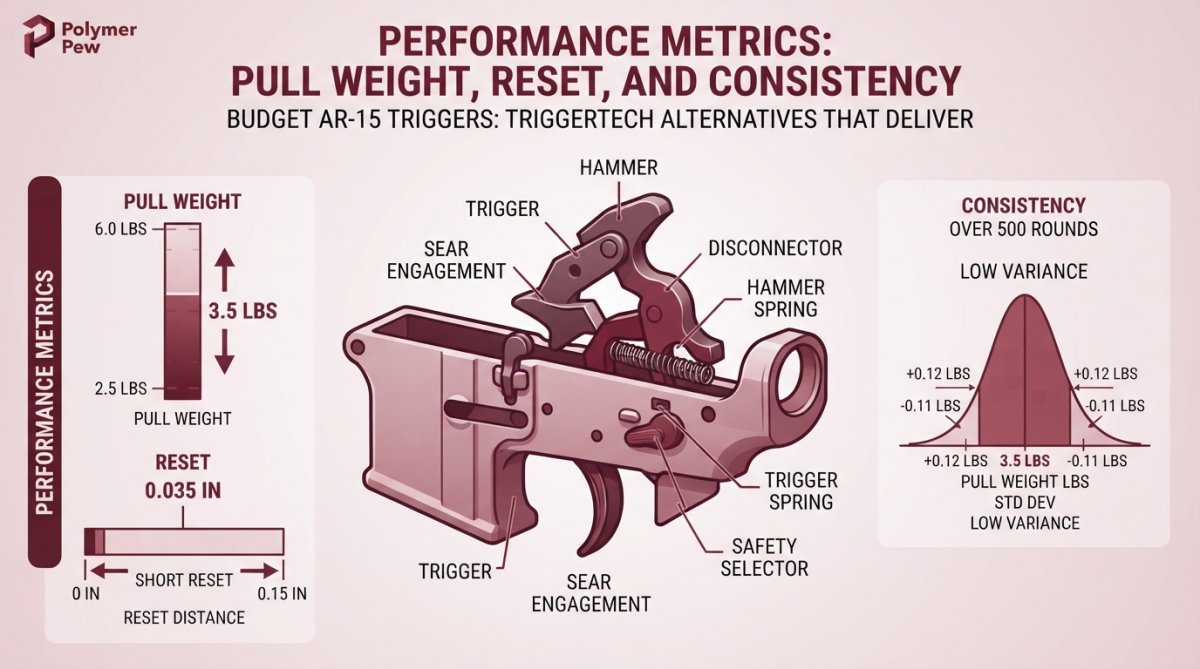
Pull weight is the force required to break the shot, measured in pounds. Lighter pulls (2.5-3.5 pounds) favor precision and competition shooting. Heavier pulls (4.5-5.5 pounds) prioritize safety and reliability in duty applications. Budget triggers typically range from 3.5 to 4.5 pounds, a balanced approach that’s light enough to feel responsive but heavy enough to prevent accidental discharge.
Reset distance is how far the trigger must travel forward after a shot before it’s ready for the next press. A short reset (1/8 inch or less) enables faster follow-up shots. The Rave 140 and Impact both feature short, crisp resets, contributing to their appeal for duty and tactical shooting.
Consistency is whether the trigger feels the same on every shot. A consistent trigger breaks at the same pressure point repeatedly. Budget triggers from quality manufacturers like Rise, Timney, and LaRue maintain excellent consistency through polished contact surfaces and quality sear engagement.
Creep is unwanted movement before the actual break. Quality budget triggers minimize creep through precise sear engagement surfaces. The Rave 140 and Impact both deliver crisp breaks with minimal creep.
Durability and Long-Term Reliability on a Budget
Quality budget triggers hold up through thousands of rounds without degradation. Poor quality triggers show wear within 500-1000 rounds. The difference comes down to material selection and manufacturing precision.
Hardened stainless steel components resist wear. Anodized aluminum housings maintain dimensional stability. Precision manufacturing ensures consistent contact surfaces that don’t degrade. Polymer Pew’s commitment to hardened stainless steel and anodized aluminum construction directly addresses durability, these materials resist corrosion and maintain performance through extended use.
Real-world reports from shooters who’ve used quality budget triggers for years show that options like Rise, Timney, and LaRue maintain performance consistently. Invest in a trigger from a manufacturer with proven track record rather than saving $20 on an unknown brand.
Choosing a budget AR-15 trigger doesn’t require compromising on performance or reliability. Quality alternatives exist at every price point and for every use case. Whether you’re building a duty rifle, a precision platform, or a general-purpose shooter, triggers like the Rise Armament Rave 140, LaRue MBT-2S, and Polymer Pew’s flat trigger kits deliver the performance that premium triggers promise at a fraction of the cost.
The key is matching the trigger type and installation method to your needs and skill level. Single-stage triggers prioritize speed and simplicity. Two-stage triggers prioritize control. Drop-in triggers eliminate assembly complexity. Assembly-required triggers reduce cost. Start with that framework, evaluate the specific options that fit your criteria, and you’ll find a trigger that transforms your build without transforming your budget.
For builders seeking proven compatibility and cost-effective reliability, Polymer Pew’s trigger systems and MKE lower receivers represent the budget-conscious approach done right: hardened stainless steel internals, anodized aluminum construction, and compatibility testing across multiple platform variants. Get your Flatties here and build with confidence that your components will perform as intended.
Frequently Asked Questions
What makes a budget AR-15 trigger reliable for long-term use?
Reliable budget triggers use hardened tool steel components, quality sear engagement surfaces, and consistent manufacturing tolerances. Look for triggers with S7 tool steel construction, nickel-boron or nickel-teflon coatings, and established track records with round-count testing. Durability depends on proper installation, regular cleaning, and using quality ammunition. Many budget options from established manufacturers hold up well over thousands of rounds when maintained properly.
How does the LaRue MBT-2S compare to premium two-stage triggers?
The LaRue MBT-2S delivers exceptional value through S7 tool steel construction, smooth first-stage take-up, and a crisp second-stage break around 4.5 lbs total pull weight. It matches the feel of triggers costing twice as much, though it requires assembly rather than drop-in installation. The trade-off is minimal setup time for significant savings. It's ideal for precision shooting and hunting where the two-stage design provides control without the premium price tag.
Should I choose a single-stage or two-stage trigger for a budget build?
Single-stage triggers offer simplicity and crisp breaks, ideal for duty use and tactical applications where speed matters. Two-stage triggers provide a controlled first stage and defined break point, better for precision shooting and competition. For budget builds, single-stage drop-in options like the Rise Rave 140 install faster and cost less, while two-stage triggers like the LaRue MBT-2S offer superior precision at a similar price but require assembly. Choose based on your shooting discipline, not just budget.
Are budget drop-in triggers compatible with all AR-15 lower receivers?
Most mil-spec drop-in triggers work with standard AR-15 lower receivers, but compatibility depends on proper mil-spec pin diameter and hammer/sear engagement geometry. Some specialized lowers or clones may have dimensional variations. Always verify compatibility with your specific lower receiver before purchase. Polymer Pew's aluminum MKE lowers are tested for variant compatibility with multiple trigger options. If you're unsure, consult the trigger manufacturer's compatibility list or contact support before installing.
How do I know if a budget trigger will hold consistent pull weight over time?
Consistent pull weight relies on quality sear engagement, hardened steel components, and proper manufacturing tolerances. Established brands like Rise Armament, Timney, and LaRue publish performance specs and have documented user feedback. Check for reviews mentioning pull weight consistency after extended use. Avoid triggers with reports of creep or variable pull weight. Proper installation with anti-walk pins and correct hammer spring engagement ensures consistency. Budget doesn't mean unreliable, quality manufacturers deliver predictable performance at lower prices.
This article was written using GrandRanker